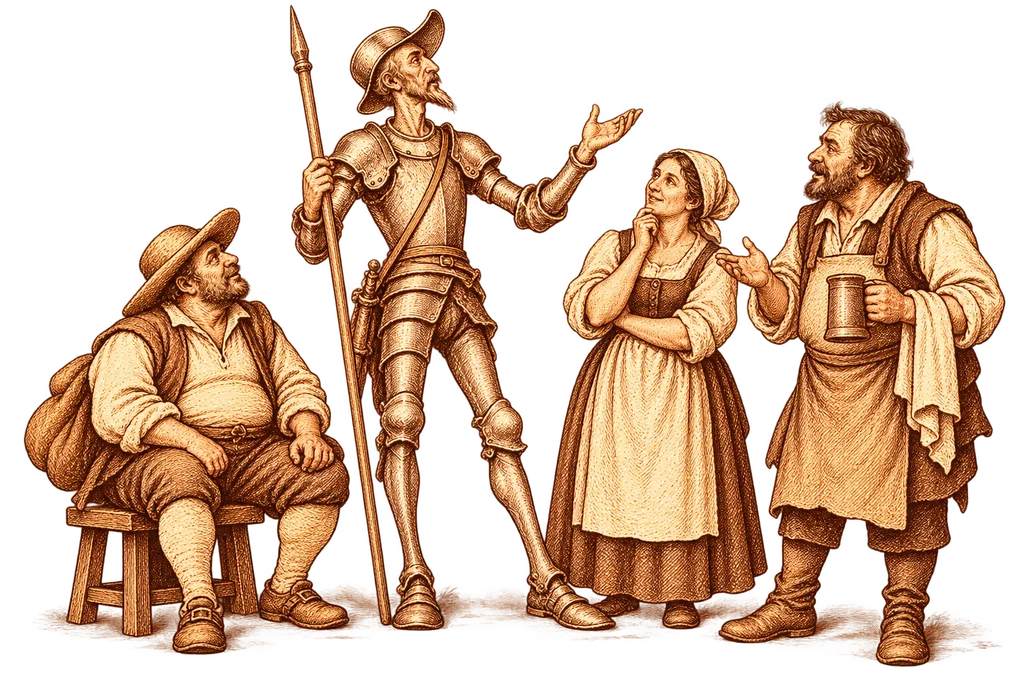
The Don Quixote characters each bring their own wishes and concerns to the story. Some travel with the knight, some challenge him, and others tell stories or arrange tricks. This guide helps you remember who they are, how they know the travelers and what changes when they meet.
On this page
This guide refers to the ending. On a first reading, look up only the people in the chapter you have just finished.
The opening characters: Names and relationships
This table covers eight figures introduced or mentioned in I.1 and I.7. The final column identifies their first reference in the novel; being mentioned does not mean someone is physically present in the scene. You can use it without knowing the ending.
| Name | Also named | Role | Connection with the gentleman | First reference |
|---|---|---|---|---|
| Don Quixote | Don Quixote of La Mancha | Country gentleman who decides to become a knight errant | He chooses a new name and plans his chivalric life. | I.1 |
| Sancho Panza | Sancho | Farmer and new squire | He is the gentleman’s neighbor and agrees to travel with him. | I.7 |
| Rocinante | — | The gentleman’s horse | The knight gives his future mount this name. | I.1 |
| Dulcinea del Toboso | Aldonza Lorenzo: The woman he remembers | The ideal lady of his chivalric project | Don Quixote reshapes his memory of her into a chivalric identity. | I.1 |
| The housekeeper | — | Member of the household | She lives in the gentleman’s house. | I.1 |
| The niece | — | The gentleman’s relative | She belongs to his household. | I.1 |
| The priest | — | The local priest | He debates the merits of literary knights with the gentleman. | I.1 |
| The barber | Master Nicolás | The village barber | He joins their discussions of chivalric books. | I.1 |
The first chapter leaves the gentleman’s surname uncertain. On a first reading, keep that uncertainty in view and distinguish his chosen chivalric name from the names suggested by the narrator.
Text supporting this table: Cervantes, I.1 · Cervantes, I.7. Supporting check in Project Gutenberg’s Spanish text.
Commentary by the QuixoteGuide editorial team. Editorial method and sources.
The traveling companions
Don Quixote is the gentleman who adopts a chivalric identity. His models come from books, but his actions meet the world beyond them. The name Alonso Quijano is established explicitly in II.74. The narrator’s uncertainty over his surname in I.1 should be preserved, rather than silently corrected.
Sancho Panza, his neighbor and squire from I.7 onward, has a wife and children and hopes to improve his circumstances. He spots the mistake about the windmills while believing that the journey might lead to a governorship. His judgments in Barataria complicate the initial description of him as a simple man.
Dulcinea: The lady Don Quixote imagines
Dulcinea del Toboso is the name Don Quixote gives to his idealized version of Aldonza Lorenzo. A woman appearing in an episode should not automatically be identified as Dulcinea. In II.10 Sancho invents the encounter, and his master explains the mismatch through enchantment. The distinction between a person, an ideal and accounts of her is part of the plot.
The household and the return
The housekeeper and niece worry about the protagonist. The priest and barber try to draw him away from his adventures. Separate their wish to care for him from the methods they use: In I.7 they conceal his library and explain its disappearance with another story of enchanters.
Sansón Carrasco knows the printed account of the travelers and discusses it in II.3. He connects village life with their public reputation. When following his later interventions, keep track of what each character knows at that point, without anticipating concealed identities.
Characters with stories of their own
Marcela and Grisóstomo belong to the pastoral episode of Part 1. After others accuse her, Marcela presents her own defense in I.14. Describing her only as the cause of a man’s suffering repeats the account her speech challenges.
The duke and duchess place the travelers in prepared situations. Sancho’s governorship depends on this environment, but his answers do not simply fulfill the role others expect him to play. The steward and other people in Barataria help build the performance around him.
Dorotea, Cardenio, Luscinda and Fernando: Two connected stories
This map includes events through I.28. The outcome in I.36 stays inside the expandable section. The four characters reach the same difficulty by different routes: Fernando comes between Cardenio and Luscinda after committing himself to Dorotea. Ormsby’s translation uses the forms Dorothea and Luscinda.
| Character | What they want | Connection to remember | Supporting chapters |
|---|---|---|---|
| Cardenio | To marry Luscinda. | He trusts Fernando and tells him about her. He later describes what he believes he witnessed at the wedding as betrayal. | I.24 and I.27 |
| Luscinda | To marry Cardenio, as her letter expresses. | Her father accepts Fernando. Her assent during the ceremony and what others learn afterward should not be treated as a single account. | I.27 and I.28 |
| Dorotea | For Fernando to acknowledge his marriage commitment to her. | She is the daughter of wealthy farmers who are subjects of Fernando’s father. Her account connects her abandonment with Cardenio’s story. | I.28 |
| Don Fernando | To marry Luscinda after his relationship with Dorotea. | He is a duke’s son and Cardenio’s friend. His social position matters in two conflicting commitments. | I.24, I.27 and I.28 |
Separate the earlier relationship from the information available to each person. In I.27, Cardenio leaves without knowing the contents of the paper found on Luscinda. In I.28, Dorotea reports what she later heard about that document and Luscinda’s commitment to Cardenio. Her account challenges his judgment of abandonment. These are connected stories in which incomplete knowledge changes other people’s decisions.
Reveal Micomicona’s role and the outcome in I.36
In I.29, Dorotea acts as Princess Micomicona to help the priest and barber draw Don Quixote out of Sierra Morena. Micomicona is a role within the story, rather than another woman to add to the map. Dorotea’s familiarity with chivalric books helps her sustain the performance, though it needs adjustments.
In I.36, the inn brings the two couples together. Luscinda asks Fernando to release her so she can reach Cardenio, while Dorotea claims his commitment to her. Fernando eventually yields. The reunion ends their separation without erasing the unequal power behind their choices. That last observation is our reading of the scene.
Check the Spanish text: I.24, I.27, I.28, I.29 and I.36. Read I.28 in Ormsby’s English translation.
Ginés de Pasamonte: From the prisoners to a concealed identity
Ginés is among the prisoners freed in I.22. He disputes the names used for him, boasts of writing his life and explains that it cannot be finished while he is still alive. Remember his claim to tell his own story: It clashes with the role of grateful beneficiary Don Quixote expects him to play after releasing him.
Reveal Master Pedro’s identity and the explanation in II.27
Master Pedro, the puppet-showman in II.25 and II.26, is Ginés de Pasamonte. The narrative reveals this in II.27. A seemingly new performer thus reconnects the story with the release of the prisoners.
The same chapter explains the monkey’s supposed knowledge: Ginés gathers information before entering towns and prepares his answers. It also identifies him as the thief of Sancho’s donkey, attributing the omission of how the theft happened in Part 1 to the printers. This is the narrative’s explanation, rather than independent historical proof about the printing. If the donkey’s loss and recovery seem discontinuous in your edition, II.27 is a useful place to begin comparing accounts.
Supporting Spanish text: I.22 and II.27. Read II.27 in Ormsby’s English translation.
Ricote and Ana Félix: Neighbors, expulsion and return
In II.54, after leaving Barataria, Sancho meets Ricote among a group of pilgrims. Ricote is a former neighbor and shopkeeper from his village who has left Spain because of the expulsion of the Moriscos and returned in disguise. Their connection precedes the adventures: Recognition turns an apparent foreigner into someone with a shared history.
Ricote wants to recover what he left hidden and discover what has happened to his family. Sancho refuses to help retrieve the treasure but promises not to report him. Reading both answers together avoids treating the scene as unqualified acceptance or rejection. Neighborly affection coexists with the fear and obedience expressed in their words.
Reveal the reunion in II.63 and the unresolved question in II.65
In II.63, in Barcelona, Ana Félix tells her story and Ricote recognizes her as his daughter. Don Gaspar Gregorio, who loves her, accompanied her into exile and has been left in Algiers. The reunion of father and daughter has not yet resolved every separation or the young man’s danger.
In II.65, Gregorio returns after his rescue. Don Antonio Moreno offers to intervene so that Ricote and Ana Félix can remain in Spain, while Ricote doubts that this can succeed. The chapter describes an intervention to be attempted, rather than permission already secured. Distinguish the relief of reunion from the unresolved question of their remaining in Spain.
Supporting Spanish text: II.54, II.63 and II.65. Read II.54 in Ormsby’s English translation. The interpretive connections are QuixoteGuide’s commentary.
How the Don Quixote characters are connected
For each encounter, note what the characters want, what they know about the travelers and what changes after the conversation. This separates assistance, self-interest, mockery and affection. Continue with Don Quixote and Sancho’s relationship or return to the chapter index.
Sources for checking this page
- Cervantes, Don Quijote, I,1
- Cervantes, Don Quijote, I,7
- Cervantes, Don Quijote, I,8
- Cervantes, Don Quijote, I,14
- Cervantes, Don Quijote, II,3
- Cervantes, Don Quijote, II,10
- Cervantes, Don Quijote, II,45
- Cervantes, Don Quijote, II,53
- Cervantes, Don Quijote, II,74
Reading options. The Centro Virtual Cervantes links lead to the Spanish text. If a passage is unavailable there, use the alternative Spanish text. For English, read John Ormsby’s Part 1 or Part 2. Keep the part and chapter number when comparing editions.