A festive visit to the galleys changes when a naval pursuit ends in threatened executions. Ana Félix’s voice forces distinctions between people initially judged together.
On this page
Characters and setting
Characters: Don Quixote; Sancho Panza; the galleys’ general; the viceroy; Ana Félix; Ricote; sailors and soldiers. Don Gregorio appears in Ana Félix’s account. Setting: The galleys and Barcelona’s coast; Algiers appears in Ana Félix’s account.
Summary
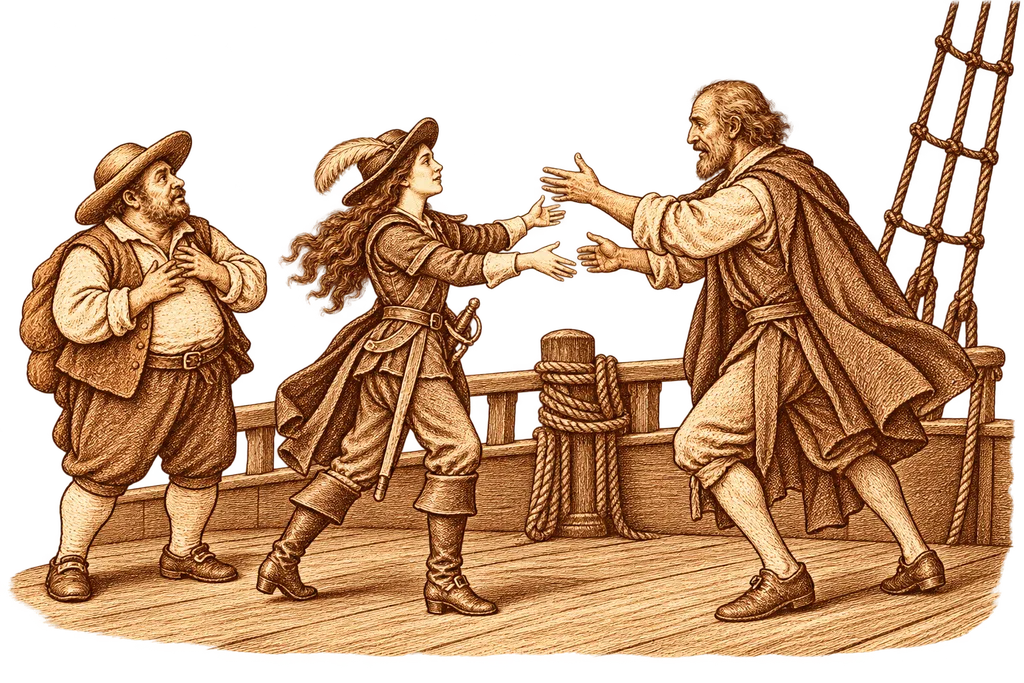
Don Quixote and Sancho receive honors aboard the galleys. Rowers pass Sancho from arm to arm, and the ship’s movements frighten him. A signal announces a brigantine; during the pursuit, two of its crew kill two soldiers. Once the vessel is captured, the general threatens to execute the prisoners. Its young captain reveals that she is Ana Félix, a Christian from a Morisco family expelled from Spain. She recounts her journey to Algiers and the danger facing her beloved Don Gregorio, whom she dressed as a woman. Ricote, present as a pilgrim, recognizes his daughter, and Sancho confirms their relationship. The general spares her; the viceroy also stops the execution of the two shooters. They arrange Gregorio’s rescue under a Spanish renegade’s direction.
What to notice
The captain’s appearance does not disclose her identity. Sancho confirms what he knows about Ricote and his daughter without endorsing every detail of their journeys or intentions.
Analysis
An individual account interrupts collective revenge. Ana Félix separates her faith and conduct from the categories behind her exile. Her beauty also influences the powerful men’s compassion: Hearing her matters, although attention is not distributed neutrally.
A reflection for today
A person’s conduct cannot be established through an identity others assign them. The chapter invites reflection on listening before making a whole group responsible. Sancho’s caution provides another precise principle: State what we know without presenting it as assurance about what we do not.
Sources and edition
This guide uses Cervantes’s text in Francisco Rodríguez Marín’s La Lectura edition (1911–1913), volume 8, II.63. Verifiable locator: Identifier donquijotedelama08cerv, scan images 164–184 (zero-based digital index). The heading and selected passages were visually checked; the complete notes were not collated. Analysis and present-day reflection are this guide’s commentary.

