
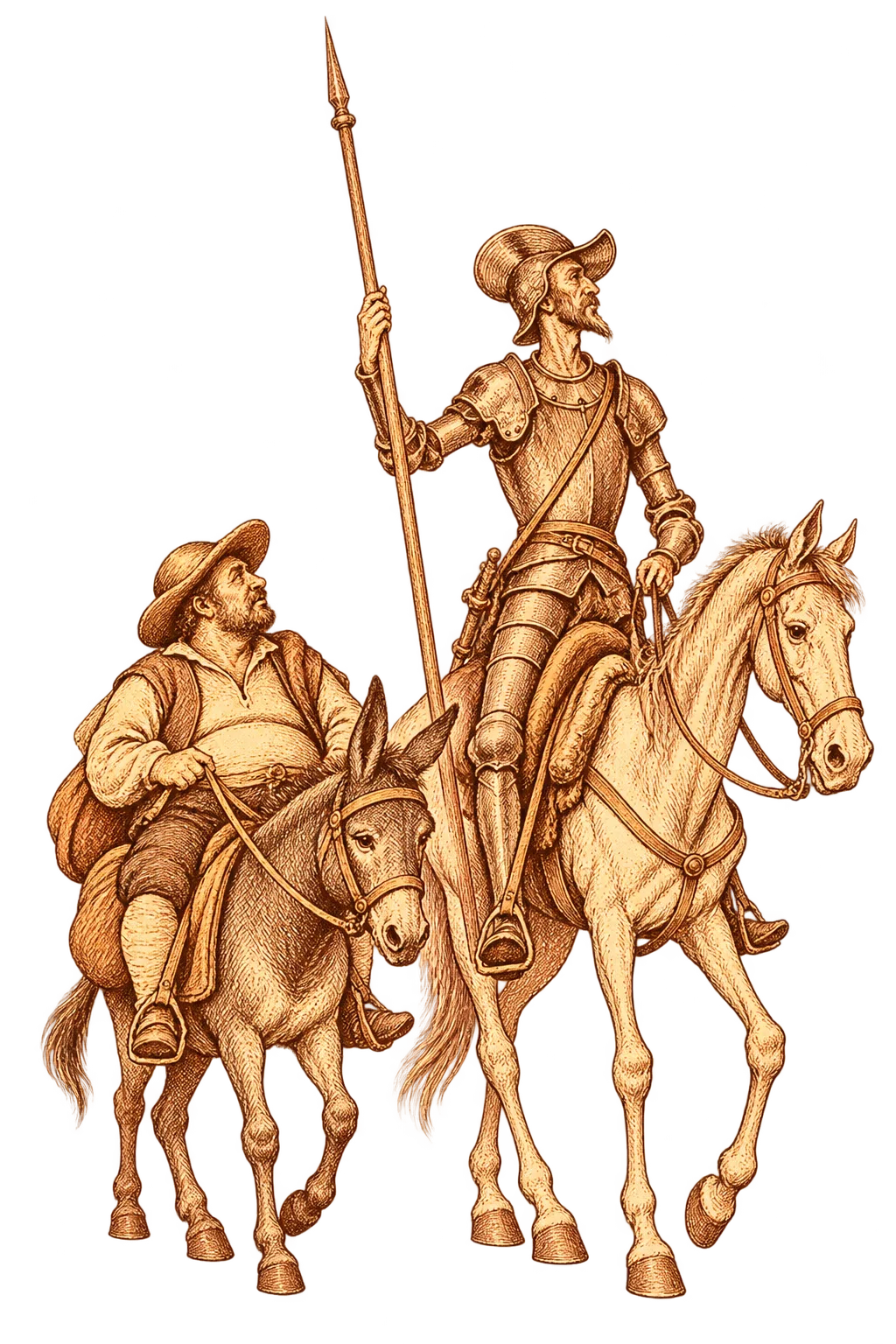
Don Quixote and Sancho Panza begin their journey with an unequal arrangement and a promise. One is the master; the other agrees to serve him because he hopes to gain a governorship. Along the way, disagreements and shared adventures lead to a friendship neither could have predicted at home.
On this page
This analysis includes the ending.
Don Quixote and Sancho: An unequal agreement
In I.7 Don Quixote promises an island, while Sancho imagines material advancement. The knight needs a squire within his chosen identity; the neighbor needs a reason to leave his household. Their expectations overlap enough to begin the journey, even though they do not speak the same language of aspiration.
Don Quixote and Sancho Panza: Friends who disagree
The windmills in I.8 expose their different perceptions. Sancho warns and Don Quixote acts. After the fall, they continue together. Their conversation includes mistakes, corrections and explanations they never fully share. Staying together does not require agreement about everything.
Our reading is that this continuity gives the conversation its narrative force. Readers observe a difference that persists and the negotiation of its consequences. Later affection does not turn every dispute into a harmonious lesson.
When the companions exchange roles
In II.10 Sancho invents the encounter with Dulcinea. Don Quixote struggles with what he sees and accepts enchantment as an explanation. The supposed representative of reality has helped create an imaginary problem.
Barataria also disrupts an easy opposition. Sancho must judge independently, away from ongoing conversation with his master. In II.45 he displays abilities that cannot be predicted from his social position. In II.53 he gives up the reward he once desired after learning its costs. Change does not require him to become a copy of Don Quixote.
The ending tests their attachment
In II.74 Alonso Quijano rejects knight errantry. Sancho tries to keep him alive through a new pastoral project. A relationship that began with promised rewards now contains concern for the other person’s existence.
Saying that they have completely exchanged personalities oversimplifies the scene. Sancho remains Sancho, and the gentleman does not become his former squire. What partly reverses is their willingness to sustain an imagined project: The companion preserves a hope the protagonist now refuses.
Questions for a closer reading
In conversations between Don Quixote and Sancho, mark who proposes, doubts, interprets and bears the consequences. Compare I.7, I.8, II.10 and II.74. This grounds development in identifiable words and actions, instead of treating “idealism” and “realism” as complete explanations.
Read the profiles of Don Quixote and Sancho Panza.