While the priest and barber plan Don Quixote’s return, Cardenio finishes a story whose crucial evidence he still does not possess.
On this page
Summary
The priest decides to exchange his maiden’s disguise with the barber. Sancho goes ahead to give his master an invented reply from Dulcinea. The other two hear Cardenio singing and invite him to resume his account.
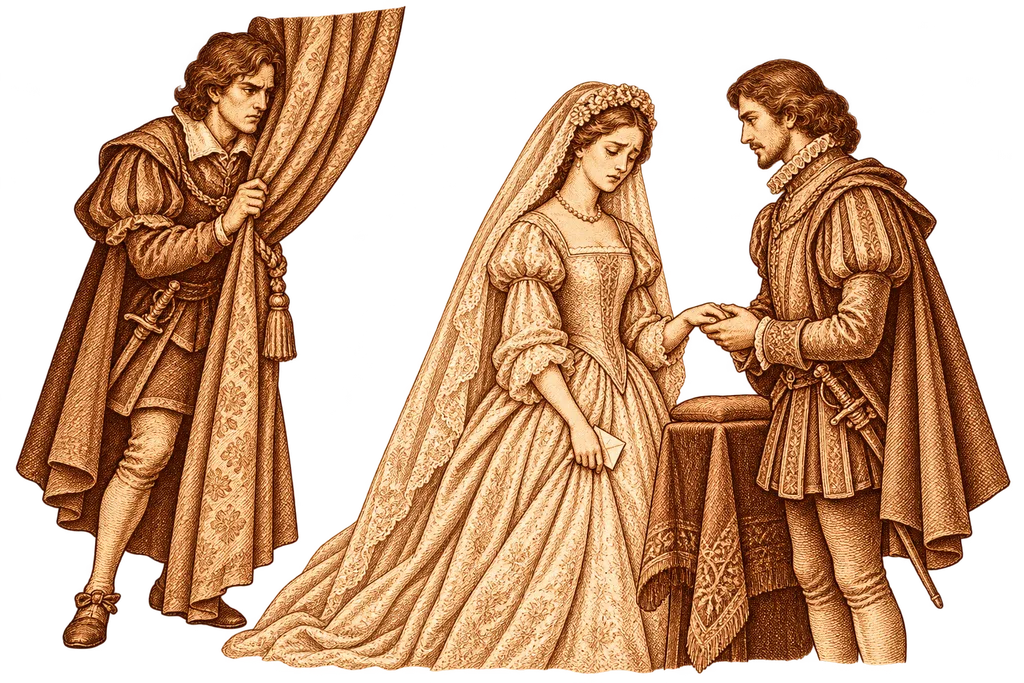
Fernando sent Cardenio away on an errand and arranged to marry Luscinda during his absence. Warned by her letter, Cardenio returned and watched the wedding from hiding. He heard her agreement, saw her faint, and noticed Fernando reading a paper found in her clothing. Without learning its contents, he fled into the mountains. There he experiences periods of clarity and distress, while local herders help feed him.
Characters and relationships
Fernando betrays Cardenio’s trust. Luscinda faces a wedding she had described with desperation. The priest and barber first become attentive listeners rather than immediate advisers. Sancho takes part in a separate deception intended to end Don Quixote’s penance.
Narration, language, and humor
The comic business of the costumes gives way to an anguished first-person narrative. The wedding is seen by a concealed witness whose grief and missing information shape his interpretation. The discovered paper creates unresolved suspense. A new voice interrupts at the end, preparing another story.
Reading reflection
Cardenio has witnessed an action without knowing its full explanation. His suffering deserves care, but his accusations against Luscinda need not be accepted as complete knowledge. The chapter separates listening compassionately from endorsing every conclusion drawn in distress.
What to watch next
Remember that Cardenio did not read the paper found when Luscinda fainted. Its contents may change how the wedding scene should be understood.
Source and reading
Cervantes’s text in Rodríguez Marín’s La Lectura edition (1911–1913), volume 3. Checked passages: P. 10, p. 12, p. 29, p. 36, p. 37, p. 41. Original summary, analysis, and reflection by QuixoteGuide.


