The victor explains his plan to send Don Quixote home. As the knight recovers, another story reaches a reunion without settling every difficulty.
On this page
Characters and setting
Characters: Don Quixote; Sancho Panza; Sansón Carrasco; Don Antonio Moreno; Ana Félix; Don Gregorio; Ricote; the renegade who arranges the rescue. Setting: Barcelona, during the knight’s recovery and preparations for departure.
Summary
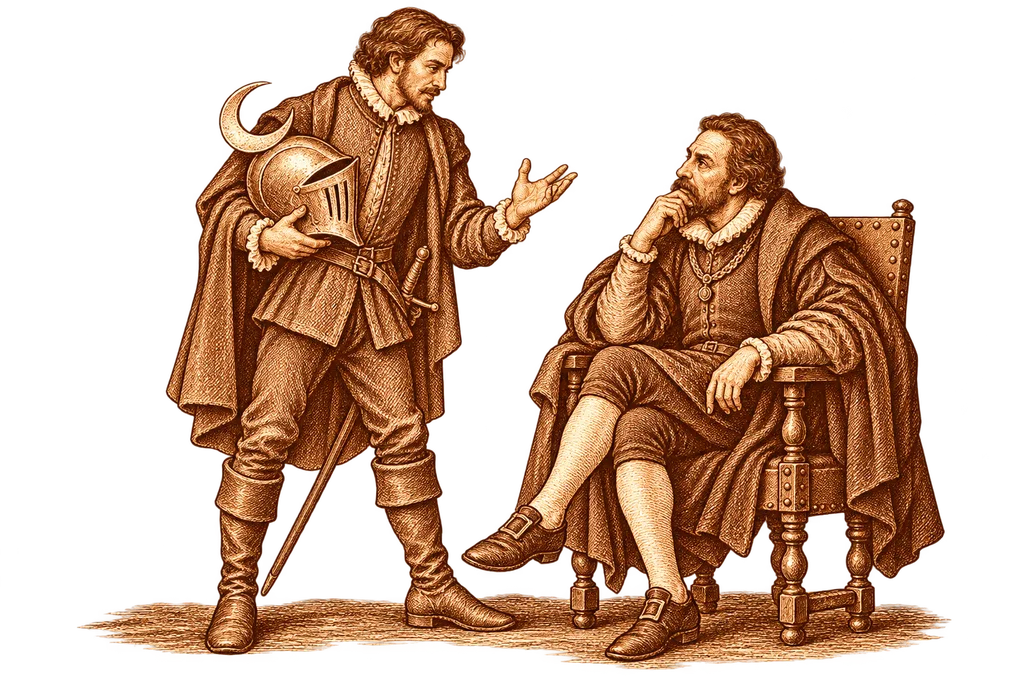
Don Antonio follows the White Moon and discovers Sansón Carrasco. The graduate describes his earlier attempt as the Knight of the Mirrors and asks that his identity remain secret so Don Quixote will honor his retirement. Don Antonio regrets losing the entertainment supplied by knight and squire. Don Quixote spends six days in bed; Sancho consoles him while mourning his own expectations of reward. The renegade returns from Algiers with Don Gregorio, who reunites with Ana Félix. Ricote rewards the rescuers. Don Antonio offers to seek permission for father and daughter to remain in Spain, though Ricote doubts that intervention will help. Gregorio travels with Don Antonio; Ana Félix and Ricote stay with their hosts while waiting. Don Quixote and Sancho begin their journey home.
What to notice
Sansón conceals an intervention he presents as assistance. Don Antonio’s objection places spectators’ pleasure against the protagonist’s welfare. The lovers’ reunion does not establish permanent permission to stay.
Analysis
Sansón’s revelation supplies an intention for the combat without erasing its cost. He wants to bring Don Quixote into the quiet he considers necessary for recovery and uses a chivalric obligation to achieve it. The strategy exploits fidelity to rules his friends regard as part of the delusion. Care operates through deception and physical defeat, rather than a freely shared decision.
Don Antonio and the viceroy regret losing the amusement provided by the knight’s adventures. Their responses require a distinction between spectators’ wishes and the welfare of the person watched. Six days of distress in bed do not become irrelevant because the scheme is presented as a remedy. Sansón’s concern, others’ pleasure and the defeated man’s experience remain in tension.
Gregorio’s return supplies a parallel relief without complete closure. Ana Félix and Ricote receive shelter and promises of intervention allowing them to remain in Spain, rather than secure authorization. The father’s reservations coexist with Don Antonio’s optimism about influence and negotiation. Comparing these outcomes prevents every well-intentioned assistance from being called a solution. One plan imposes a return; another seeks permission to stay, while those affected remain dependent on powerful decisions.
A reflection for today
Helping someone requires attention to their welfare beyond the interest they inspire. The chapter invites scrutiny both of protective deception and of wanting someone to remain entertaining. A partial solution can be acknowledged without announcing an outcome that has not occurred.
Sources and edition
This guide uses Cervantes’s text in Francisco Rodríguez Marín’s La Lectura edition (1911–1913), volume 8, II.65. Verifiable locator: Identifier donquijotedelama08cerv, scan images 196–208 (zero-based digital index). The heading and selected passages were visually checked; the complete notes were not collated. Analysis and present-day reflection are this guide’s commentary.
Read the chapter in English. Read Part 2, Chapter 65 in English in John Ormsby’s translation, via Project Gutenberg. Compare it with the Spanish source cited above; our summary and commentary are separate from the translation.