The narrator explains the monkey's apparent marvel before returning to the quarrel between villages. Don Quixote tries to prevent battle, but Sancho's demonstration breaks the negotiation.
On this page
Characters and setting
Characters: Don Quixote, Sancho and the men of the braying village. Ginés de Pasamonte is revealed as Maese Pedro’s identity. Setting: The road and the place where the village’s armed group has gathered.
Summary
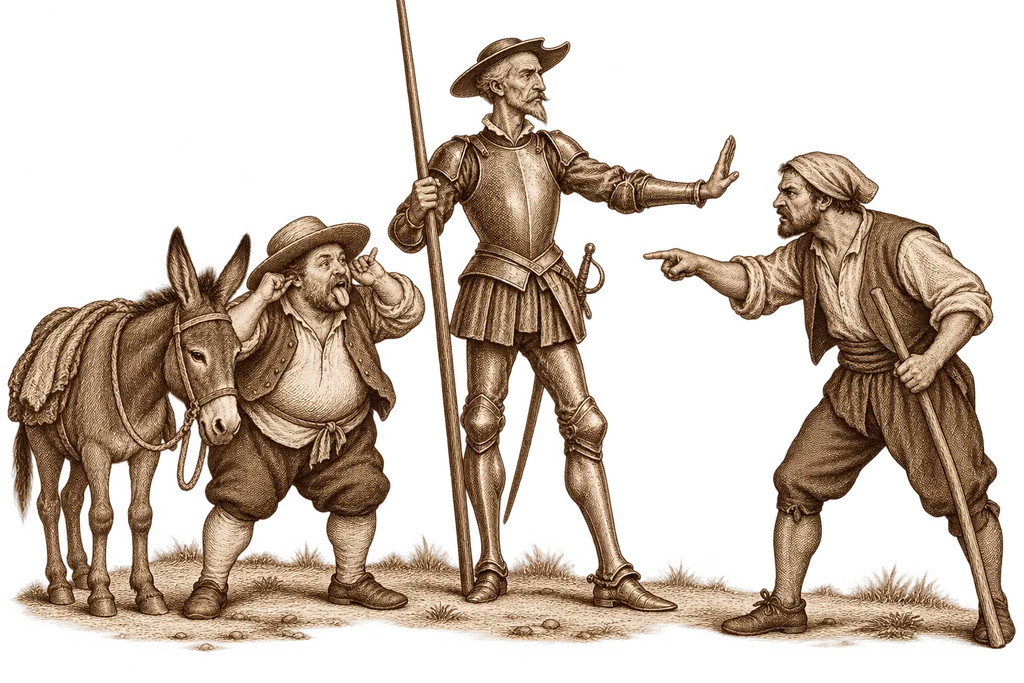
Cide Hamete reveals that Maese Pedro is Ginés de Pasamonte, disguised to evade the authorities. He gathers information beforehand and makes the monkey appear to whisper answers. The travelers later find the braying village's armed group. Don Quixote argues that mockery cannot justify such violence and urges restraint. Sancho supports him and demonstrates his own bray to show that the ability is not dishonourable. A man takes it as mockery and knocks him down. Don Quixote tries to intervene but retreats when threatened by the crowd. Sancho follows on his donkey.
What to notice
The explanation of the monkey replaces supernatural appearances with information gathered in advance. In the second scene, Sancho's intended meaning differs from his listeners' interpretation.
Analysis
The chapter joins deliberate deception with a misunderstanding that becomes violent. Don Quixote argues prudently, but his argument cannot hold when the audience feels insulted again. Context changes the effect of an ability Sancho considers harmless.
A reflection for today
An example may be badly timed even when offered in support of a reasonable idea. Sancho's bray encourages us to consider listeners' mood and a gesture's associations before using it as a demonstration.
Sources and edition
This guide uses Cervantes’s text in Francisco Rodríguez Marín’s La Lectura edition (1911–1913), volume 6, II.27. Verifiable locator: Identifier donquijotedelama06cerv, scan images 180–194 (zero-based digital index). The heading and selected passages were visually checked; the complete notes were not collated. Analysis and present-day reflection are this guide’s commentary.

