Illness brings an ending the narrative makes definitive. Don Quixote regains his judgment, recognizes himself as Alonso Quijano and settles his affairs amid the grief of those who love him.
On this page
Characters and setting
Characters: Alonso Quijano, formerly Don Quixote; Sancho Panza; the priest; Sansón Carrasco; the housekeeper; Antonia Quijana; the doctor and notary. Cide Hamete closes the narrative. Setting: Alonso Quijano’s home in his village.
Summary
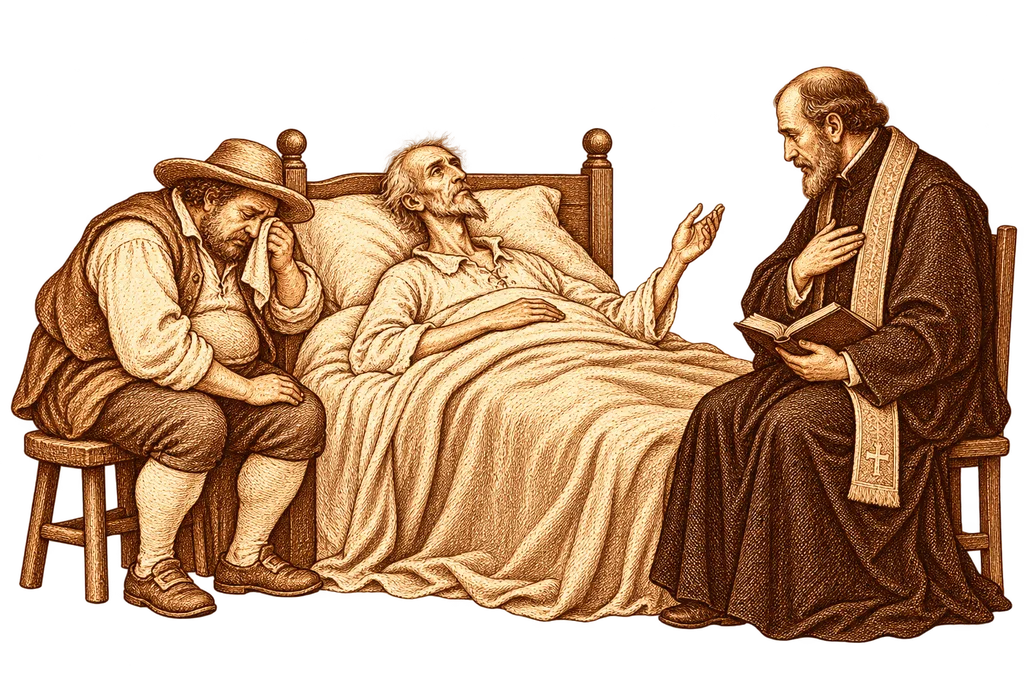
A fever keeps the knight in bed for six days. Friends try to encourage him with their pastoral plan, but the doctor fears for his life. After sleeping, he declares his judgment clear and rejects chivalric books: He is now Alonso Quijano the Good. He asks to confess and make his will. Sancho may keep the money remaining after paying himself what is owed, and Alonso asks his forgiveness. Weeping, the squire urges him to live and become a shepherd. Alonso maintains his rejection of chivalric fantasies. He leaves his property to Antonia Quijana, subject to a condition about marriage and chivalric books, provides wages and an allowance for his housekeeper and mentions the rival sequel’s author. He dies after receiving the sacraments. The priest requests testimony of death to prevent invented new adventures; Cide Hamete closes the story by defending his bond with its protagonist.
What to notice
The narrator offers possible causes of the illness rather than one definitive medical explanation. Sancho hopes their imagined project can preserve life and companionship. Death is explicitly confirmed.
Analysis
Recovered judgment does not restore the future his friends are trying to offer. While they propose pastoral life to encourage him, the sick man identifies himself as Alonso Quijano and rejects chivalric books. Lucidity dismantles a project without cancelling the affection formed through it. The narrator recalls kindness under both names, preventing the relationship from being reduced to a mistake that can simply be erased.
The will replaces marvelous promises with material arrangements. Sancho may deduct what is owed and retain the balance; the housekeeper receives wages and an additional sum; the niece inherits under a condition concerning her prospective husband’s reading. Reviewing his life includes gratitude and a request for forgiveness, but also decisions of control readers can assess separately. Announcing sanity does not resolve every question.
Sancho tries to restore his master’s desire to live through the very fictions he once disputed. This reversal shows how companionship has come to matter beyond literal belief in each adventure. Certification of death and Cide Hamete’s farewell also close the argument about continuations. The ending concludes a life and protects a history against further appropriation, without preventing readers from returning to it.
A reflection for today
Supporting someone can require hearing how they wish to revise their own story. The chapter invites reflection on gratitude, repair and concrete care without making the ending a simple triumph of reason or rejection of all imagination. Sancho’s affection survives his friend’s change of identity.
Sources and edition
This guide uses Cervantes’s text in Francisco Rodríguez Marín’s La Lectura edition (1911–1913), volume 8, II.74. Verifiable locator: Identifier donquijotedelama08cerv, scan images 322–338 (zero-based digital index). The heading and selected passages were visually checked; the complete notes were not collated. Analysis and present-day reflection are this guide’s commentary.
Read the chapter in English. Read Part 2, Chapter 74 in English in John Ormsby’s translation, via Project Gutenberg. Compare it with the Spanish source cited above; our summary and commentary are separate from the translation.