A new voice in the mountains introduces Dorotea and connects her abandonment to Cardenio’s misfortune.
On this page
Summary
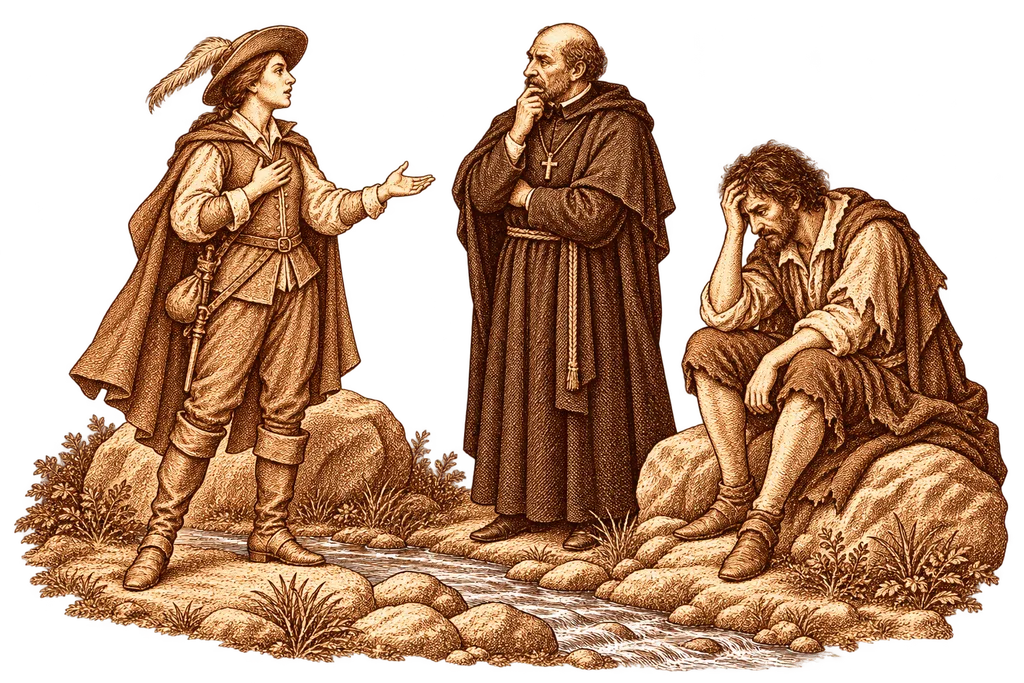
The priest, barber, and Cardenio discover a young woman wearing men’s clothes. After trying to flee, Dorotea agrees to tell her story. The daughter of prosperous farmers, she managed the family estate before Fernando began pursuing her.
Fernando entered her room at night. Dorotea asserted her dignity and demanded marriage; persuaded by his vows and afraid that he might use force, she accepted the union he promised before her maid. He then abandoned her. While searching for him, she heard a townsman’s account of Luscinda’s wedding: The discovered paper declared that Luscinda was Cardenio’s wife. During her flight, Dorotea defended herself against a servant who tried to force her and later escaped an employer who also harassed her.
Characters and relationships
Dorotea and Cardenio have both suffered through Fernando, but she brings information he lacks. Her parents and her management of their estate establish a substantial life before her misfortune. Fernando’s social position makes their unequal situation more acute.
Narration and language
Dorotea’s autobiographical account overturns the travelers’ first impression. Her speech to Fernando distinguishes being a vassal from personal enslavement and asserts equal dignity. Her news about Luscinda is reported testimony, not something she witnessed. The story’s gravity contrasts with the opening narrator’s playful attention to inserted narratives.
Reading reflection
Dorotea repeatedly has to explain her actions while men break promises or try to overpower her. Seeing only a beautiful victim would erase her competence and acts of self-defense. Her account asks readers to recognize harm without allowing it to define the whole person.
An important distinction
Dorotea does not know whether the servant she pushed down a precipice survived. The account does not establish his death.
Source and reading
Cervantes’s text in Rodríguez Marín’s La Lectura edition (1911–1913), volume 3. Checked passages: P. 54, p. 61, p. 65, p. 71, p. 74, p. 75. Original summary, analysis, and reflection by QuixoteGuide.


