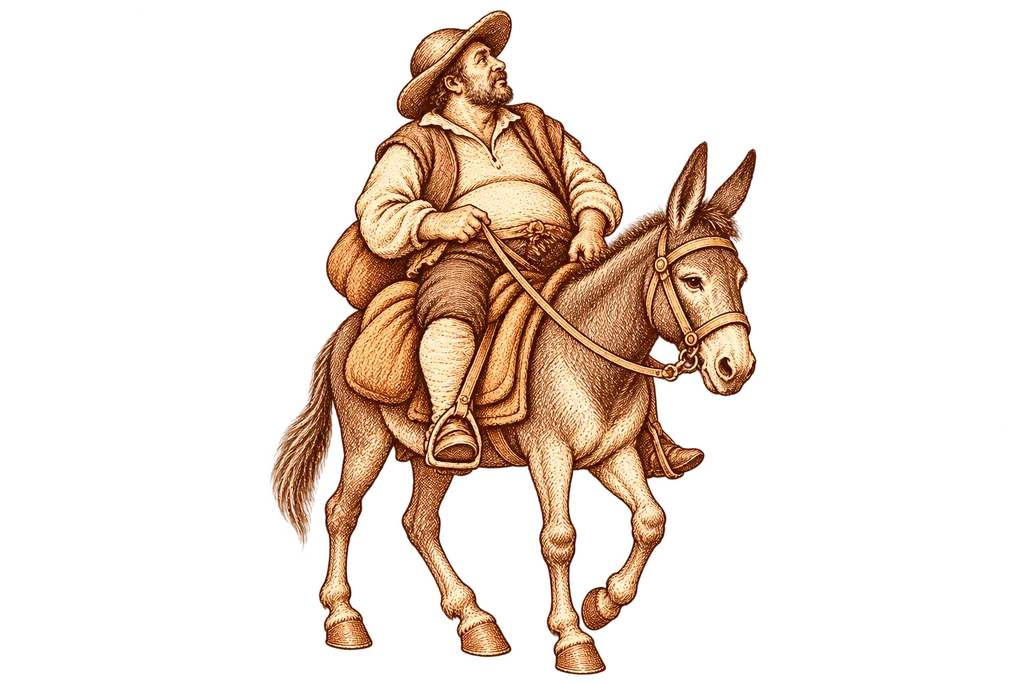
Sancho Panza becomes Don Quixote’s squire on the second journey, in I.7. He is a farmer with a wife and children. The promise of governing an island gives him a practical reason to leave home, but it does not explain every choice he makes during the adventure.
On this page
This page includes spoilers for Barataria and the ending.
Spotting mistakes while accepting promises
In I.8 Sancho recognizes that the supposed giants are windmills. Accurate observation does not protect him from every questionable expectation: The prospect of a governorship still attracts him. He can correct his master’s perception while participating in the project built around it.
Calling Sancho simply “reality” opposite Don Quixote’s “fantasy” therefore leaves too much out. The contrast describes some exchanges but misses the ambition, hope and decisions they share.
Sancho Panza invents the meeting with Dulcinea
In II.10 he presents a group of peasant women as if one were Dulcinea. The explanation of enchantment emerges when Don Quixote cannot see the lady he expects. Sancho actively shapes the account; he does more than receive or correct other people’s stories.
Separate what each man sees from what he tells the other. This distinction helps trace the creation of a deception and the obligations that follow from it.
Sancho Panza as governor of Barataria
The governorship of Barataria, arranged in the duke and duchess’s circle, unexpectedly fulfills the promise that started his journey. In II.45 Sancho must settle disputes. A lack of formal education does not prevent him from looking for evidence and developing answers. Readers can assess his judgments while remembering that the setting was created for other people’s amusement.
After a staged attack, he abandons the office in II.53. He returns to his donkey and the freedom he has lost. Our reading is that giving up the position involves more than failure: Sancho recognizes costs in the imagined reward that he does not wish to bear.
From self-interest to attachment
At the end, when Alonso Quijano rejects knight errantry, Sancho urges him to live as a shepherd. He again offers a shared fiction, now to support his friend. Affection does not erase the relationship between master and squire, but adds something their original bargain could not anticipate.
Compare I.7, II.45, II.53 and II.74. Ask what Sancho hopes to gain, what experience teaches him and what he wants to preserve. Continue with Don Quixote and Sancho together.