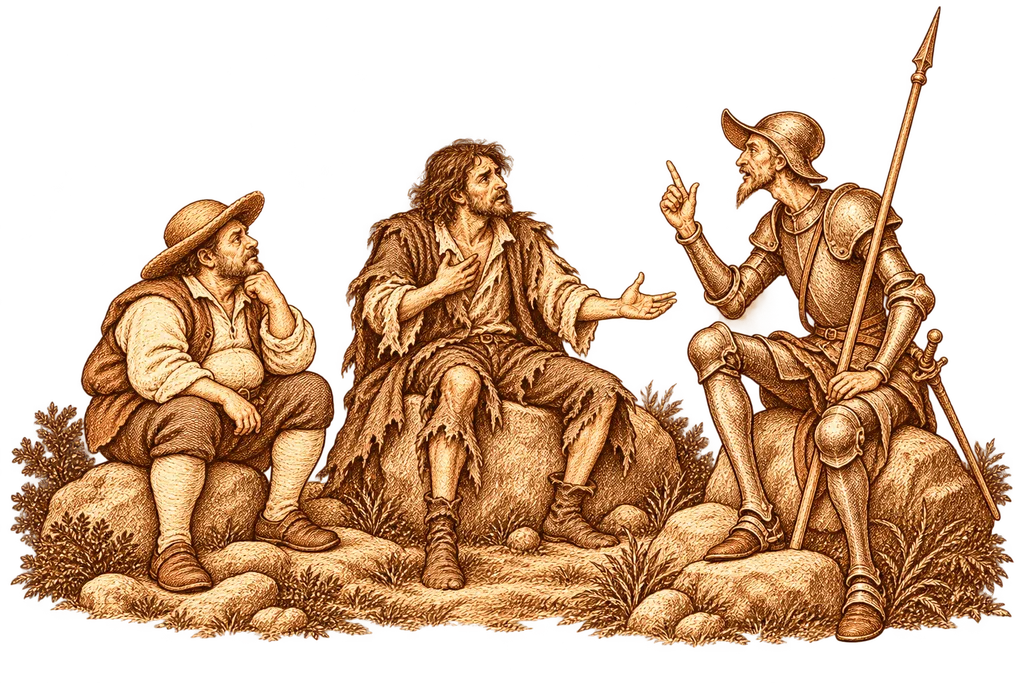
The stranger names himself Cardenio and asks for one condition: An uninterrupted hearing. Don Quixote’s literary enthusiasm prevents it.
On this page
Summary
After eating, Cardenio begins his account. He has loved Luscinda since youth and wants to marry her. Before the marriage is arranged, his father sends him to Duke Ricardo’s household. There he becomes a friend of Fernando, the duke’s younger son.
Fernando desires a countrywoman and promises to marry her. Traveling with Cardenio to his home town, he meets Luscinda and becomes interested in her. Cardenio notices his attention to their letters. When he mentions Luscinda’s reading of Amadís, Don Quixote interrupts to praise romances. Cardenio becomes disturbed again and makes a claim about Queen Madásima that enrages the knight. The argument ends in blows, and Cardenio returns to the hills.
Characters and relationships
Trust in Fernando leads Cardenio to share his relationship with Luscinda. His account presents the growing danger from his perspective without yet resolving it. Don Quixote wants to comfort him but defends a literary character more vigorously than he listens to the person present.
Narrative techniques
The main narrative receives a first-person story and suspends it before its conclusion. The rule against interruption recalls Sancho’s goat story and turns listening into a problem within the novel itself.
Humor, language and narrator
An argument about a fictional queen crosses actual suffering with bookish concerns. The narrator emphasizes that the knight defends her as though she were a living lady.
Reflection
Offering help requires room for another person’s account. Don Quixote has compassionate words, but his own interest redirects the conversation. The chapter asks how much we hear when every detail becomes an invitation to return to our favorite subject.
Source and reading
Cervantes’s text in Rodríguez Marín’s La Lectura edition (1911–1913), volume 2. Checked passages: P. 262, p. 268, p. 274, p. 278. Original summary, analysis, and reflection by QuixoteGuide.


