To understand the character of Don Quixote, follow the choices he makes as a country gentleman determined to become a knight errant. He changes his name, takes up old armor and chooses Dulcinea as his lady. His hopes then meet a world that rarely behaves like the books he has read.
On this page
This page discusses the ending.
Don Quixote: A new name and a purpose
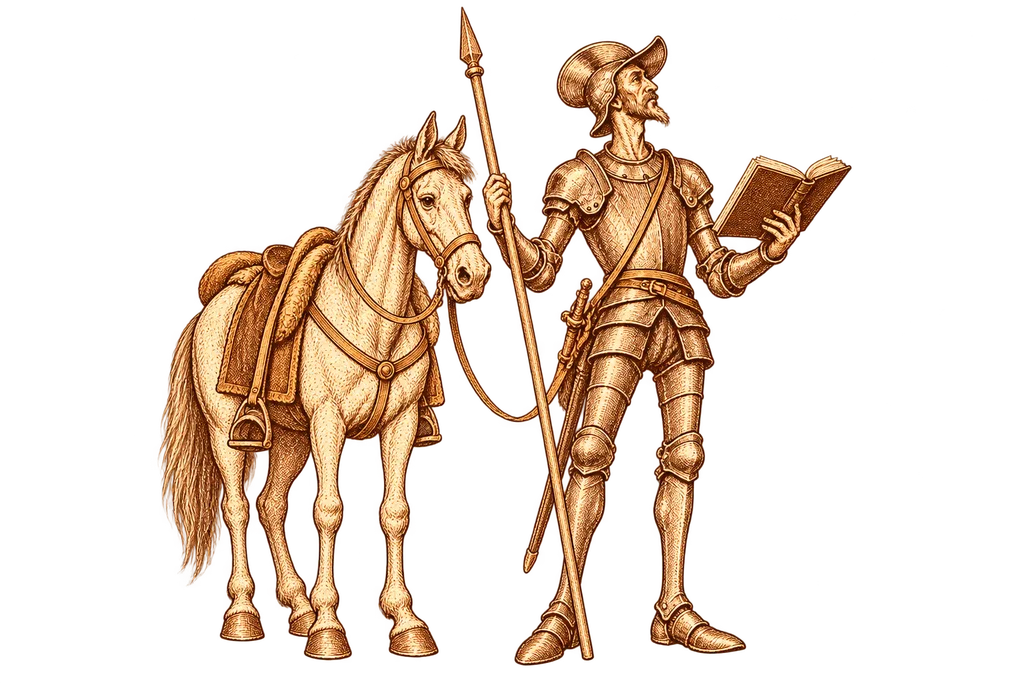
In I.1 he prepares inherited armor, calls his horse Rocinante and takes the name Don Quixote of La Mancha. He also creates Dulcinea del Toboso from his idea of Aldonza Lorenzo. The chivalric identity requires connected roles: Horse, armor, lady and adventures must belong within it.
The narrator initially hesitates over the gentleman’s surname. In II.74 the protagonist explicitly identifies himself as Alonso Quijano the Good. The difference invites attention to how a person is introduced before the story has finished shaping him.
Good intentions and harmful results
His declared purpose is to remedy wrongs and gain honor. Intention does not guarantee the result. In I.8 his resolve to defeat giants sends him against windmills and endangers both Rocinante and himself. Sancho provides an accurate explanation, but Don Quixote does not accept it before acting.
Our interpretation is that the episode tests a well-meant action through the way its assumptions are examined. Admiring the ideal of justice is insufficient; we must also ask who is affected and which evidence has been excluded.
Mistakes and deliberate imitation
His penance in the Sierra Morena, in I.25, adds a complication. He deliberately imitates chivalric models. His behavior does not always arise from misidentifying a physical object: Sometimes he considers how best to perform a chosen role. Reading both kinds of episode prevents us from treating his conduct as uniform.
He can also listen to someone else’s argument. Marcela’s defense of her freedom contrasts with the accusations surrounding her. Study his responses in particular situations before making him the representative of a complete doctrine.
Don Quixote’s fame and public image
In II.3 he learns of the book about his travels. He now has a public image that others can use. In II.59 the continuation attributed to Avellaneda brings a competing version of his identity into the story. He must contend with accounts written about him as well as the models he has read.
Defeat and the ending
Defeat by the Knight of the White Moon restricts his freedom to continue traveling. In II.74 he rejects knight errantry and reclaims the name Alonso Quijano. Sancho’s grief keeps the conclusion from becoming a cheerful correction without loss. The ideal that produced mistakes had also sustained their relationship.
Read the Sancho profile and their relationship guide to follow the knight’s development through an ongoing conversation.