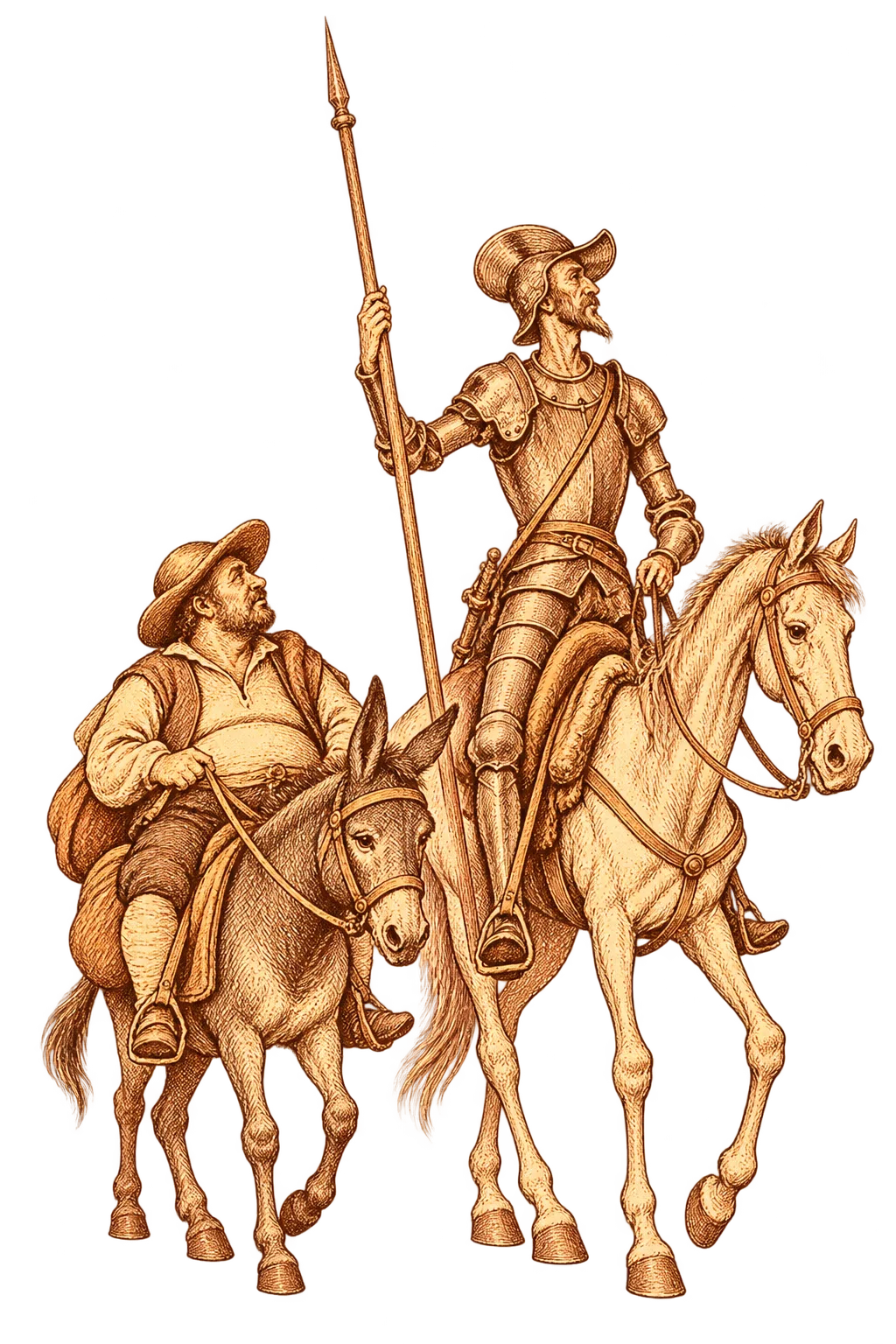
Reading Don Quixote begins with a question: What happens when someone learns to understand the world through the books he reads? Cervantes turns that question into a journey of encounters, arguments and choices. This guide helps you follow the story, keep track of its characters and notice moments that reward a closer look.
On this page
Explore the chapters · Read the overall summary
Choose your starting point in Don Quixote
If this is your first reading, start with how to read Don Quixote. Get your bearings before opening the novel, then return when a reference or a shift in the narration raises a question. To discover the plot as you go, save chapter summaries until after you have read each chapter.
If you are already reading, use the Part 1 index or the Part 2 index. Checking both the part and chapter number helps you find the right episode when the two parts reuse a number.
Follow the characters as well as the adventures
The relationship between Don Quixote and Sancho Panza gives you one way to follow the novel: Look at what each expects, how the other responds and what follows from their choices. The character guide helps you remember who takes part in each encounter.
The windmills episode offers a familiar starting point. Reading the scene alongside what comes before and after it, and considering the characters’ explanations, gives you more to work with than the famous image alone.
Turn the story into questions of your own
Once you know what happens, consider how the scene is told. Who offers an account of events? What does the reader know that a character does not? When does an expectation change how someone interprets a situation? Themes and analysis introduces ways to read, while individual chapter discussions connect those questions to particular episodes.
Connections to life today are our own interpretations. They invite discussion with the text: You can challenge a reading, return to the scene and develop a different view.
Find an edition that suits your reading
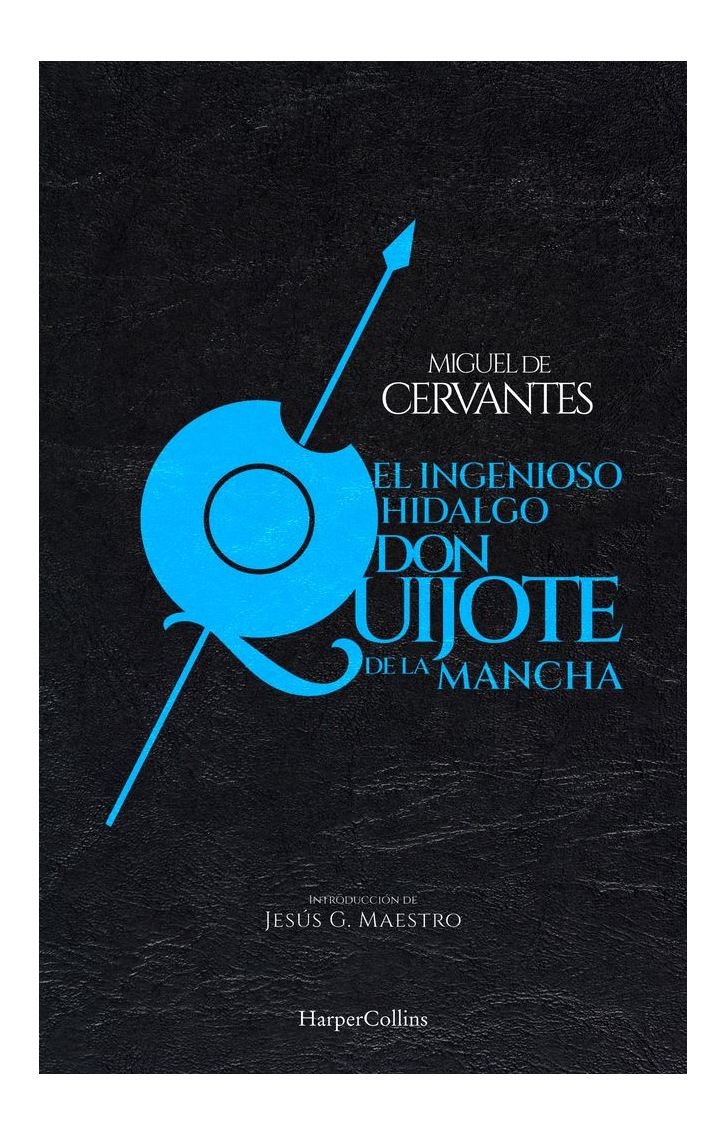
The edition and translation guide helps you compare language, notes, format and reading priorities. The Spanish edition with a critical introduction by Jesús G. Maestro has a dedicated book page, alongside a guide to Maestro and his work on Cervantes. It is an edition in Spanish, rather than an English translation.
You can read about our sources and editorial method or switch to the Spanish guide as you explore.
You can check the original Spanish text in Don Quixote at the Centro Virtual Cervantes. Use the part and chapter number to locate each episode.