Cardenio and Dorotea’s stories come together, then give way to a performance meant to lead Don Quixote out of the mountains.
On this page
Summary
Cardenio identifies himself to Dorotea and regains hope after hearing about Luscinda’s declaration. He promises to help her make Fernando honor his commitment. Both accept the priest’s offer to accompany him to his village.
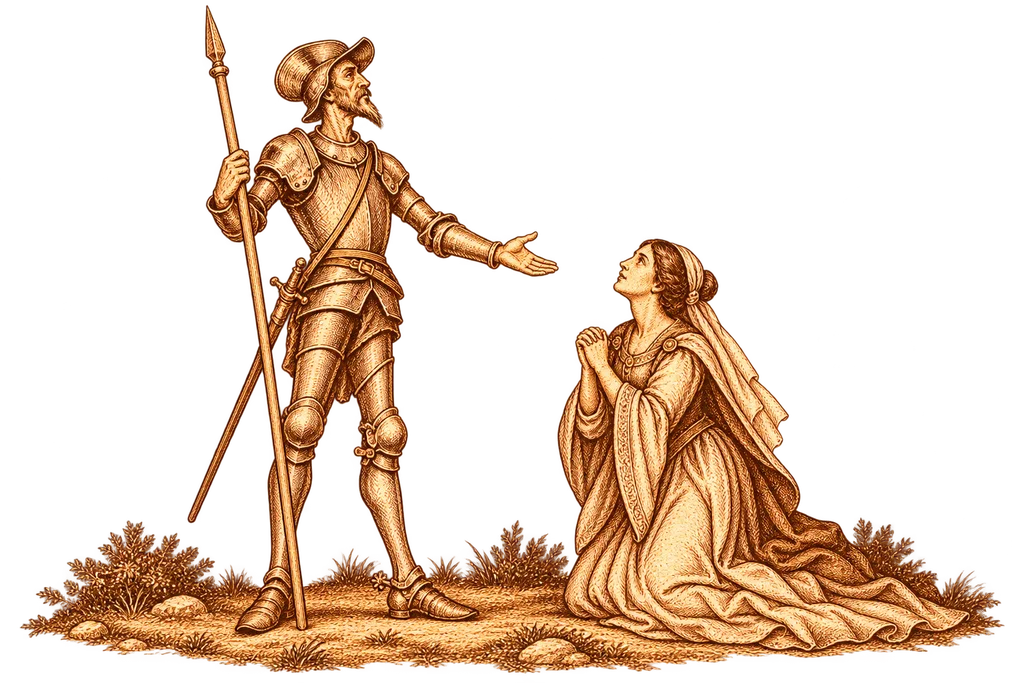
Having read romances of chivalry, Dorotea volunteers to play a distressed princess. As Micomicona, she asks Don Quixote to follow her and recover her kingdom without taking up other adventures. He agrees and ends his penance. The priest and Cardenio join the party in prepared appearances. When the barber’s false beard falls off, the priest restores it with a supposed miraculous remedy. He later invents a robbery blamed on the freed galley prisoners to unsettle Don Quixote.
Characters and relationships
Dorotea moves from telling her own misfortune to acting an invented one. The priest directs the plan and the barber supports it with his disguise. Don Quixote and Sancho believe in the princess, but Sancho mainly anticipates the rewards of a royal marriage.
Narration, humor, and language
Dorotea can perform a princess because she recognizes the style of requests she has encountered in chivalric books. That knowledge does not make her believe she is Micomicona. It lets her construct an appeal for someone who will accept that world as a frame. The same literary genre becomes the recipient’s conviction and the performer’s conscious instrument.
Her plea gives the knight a task compatible with his identity, turning departure from the mountains into the fulfillment of a duty. The rescuers need not persuade him to stop being Don Quixote before setting him on the road. Their success nevertheless depends on unequal information. Readers and organizers know the device that its recipient does not. Sancho supplies his own expectation of benefits when he hears about a kingdom.
The barber’s falling beard threatens that separation. Part of the disguise becomes visible away from its proper place and could expose the performance. The response incorporates the accident into an explanation compatible with the ongoing story instead of stopping it. The scene examines the cooperation required to sustain a fiction. A persuasive plot is insufficient unless its participants also repair what bodies and objects disrupt.
Reading reflection
Sancho’s ambition takes a disturbing turn when he imagines selling the supposed kingdom’s Black inhabitants in Spain to enrich himself. This fantasy of enslavement should not be treated as harmless ingenuity. The comedy of social advancement also reveals how a desire for profit can erase other people’s humanity.
What to distinguish
Micomicón and the giant’s wrongdoing belong to the performance. Cardenio’s promise of help addresses the personal history Dorotea has actually related.
Source and reading
Cervantes’s text in Rodríguez Marín’s La Lectura edition (1911–1913), volume 3. Checked passages: P. 82, p. 84, p. 91, p. 94, p. 99. Original summary, analysis, and reflection by QuixoteGuide.
Read the chapter in English. Read Part 1, Chapter 29 in English in John Ormsby’s translation, via Project Gutenberg. Compare it with the Spanish source cited above; our summary and commentary are separate from the translation.