Sancho finds a way out of his earlier lie by presenting a stranger as Dulcinea. This time Don Quixote sees the ordinary woman while his squire supplies the fantastic explanation.
On this page
Characters and setting
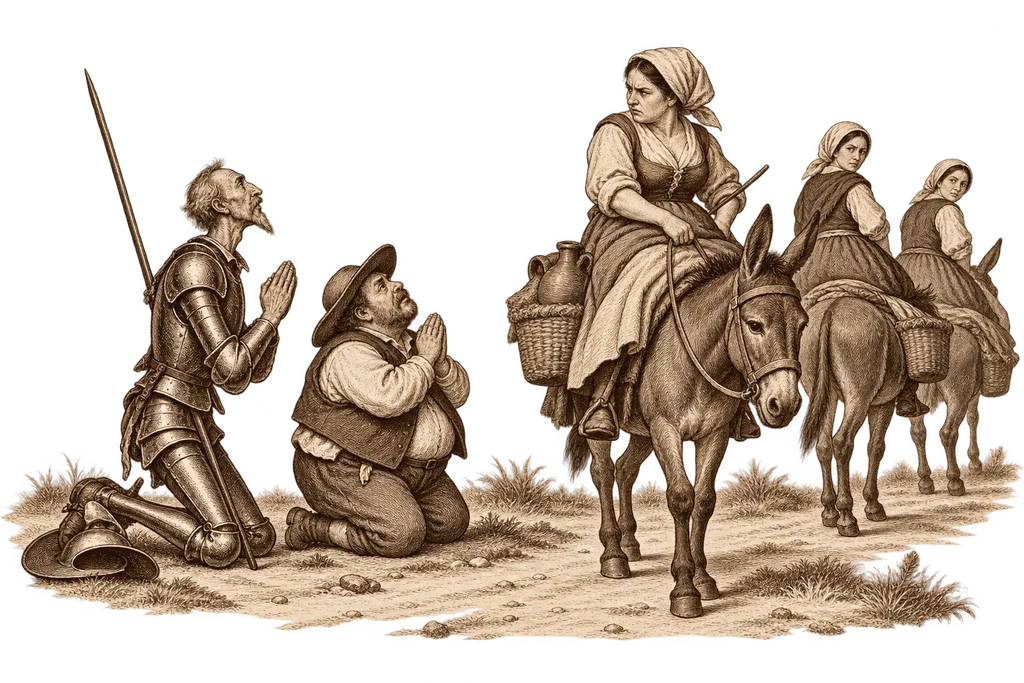
Characters: Don Quixote, Sancho and three peasant women; Sancho presents one of them as Dulcinea. Setting: The outskirts of El Toboso.
Summary
With his master waiting outside El Toboso, Sancho decides to exploit his belief in enchanters. Three peasant women pass on their donkeys, and he announces Dulcinea and her attendants. Don Quixote sees only countrywomen. Sancho insists that a great lady stands before them, and they kneel to one woman, who wants to continue her journey. After trouble with her mount, she gets back on with remarkable agility and leaves. The knight concludes that an enchanter has distorted his perception of Dulcinea. Sancho struggles not to laugh.
What to notice
The trick does not begin with Don Quixote spontaneously mistaking the woman. He sees her ordinary appearance; Sancho asserts a different identity and supplies the means of explaining the contradiction.
Analysis
Sancho constructs the encounter using an explanation he understands well. He presents three countrywomen as Dulcinea and her attendants, confident that his master can assign discrepancies to enchanters. Crucially, Don Quixote initially sees what the reader sees: Women from the countryside riding their animals. He does not independently turn an ordinary perception into a grand lady. His squire’s insistence leads him to distrust something he can distinguish clearly for himself.
The woman they address wants to continue her journey and speaks without participating in the ideal prepared for her. Her language and her agile remounting do not prove that she is Dulcinea; they are an unknown person’s actions upon which the travelers impose an identity. Readers know Sancho’s calculation and can separate human deception from supposed enchantment. Yet this convenient solution creates a cost for its inventor. Explaining absence through transformation produces another problem capable of demanding later remedies. Ask what Sancho resolves immediately and what remains open. He avoids locating a house, but introduces an altered Dulcinea whose continuing role will exceed the maintenance of a private lie between the two companions.
A reflection for today
An explanation becomes difficult to correct when every contrary observation is treated as proof of a cover-up. This scene invites us to distinguish a claim that can be checked from a story designed to protect another story.
Sources and edition
This guide uses Cervantes’s text in Francisco Rodríguez Marín’s La Lectura edition (1911–1913), volume 5, II.10. Verifiable locator: Identifier donquijotedelama05cerv, scan images 177–200 (zero-based digital index). The heading and selected passages were visually checked; the complete notes were not collated. Analysis and present-day reflection are this guide’s commentary.
Read the chapter in English. Read Part 2, Chapter 10 in English in John Ormsby’s translation, via Project Gutenberg. Compare it with the Spanish source cited above; our summary and commentary are separate from the translation.