The themes of Don Quixote become clearer when you return to specific scenes. The windmills, Marcela’s defense and Sancho’s government offer ways to explore fiction, freedom and humor. The readings below explain our interpretations so you can compare them with your own.
On this page
Themes of Don Quixote: Reality and fiction
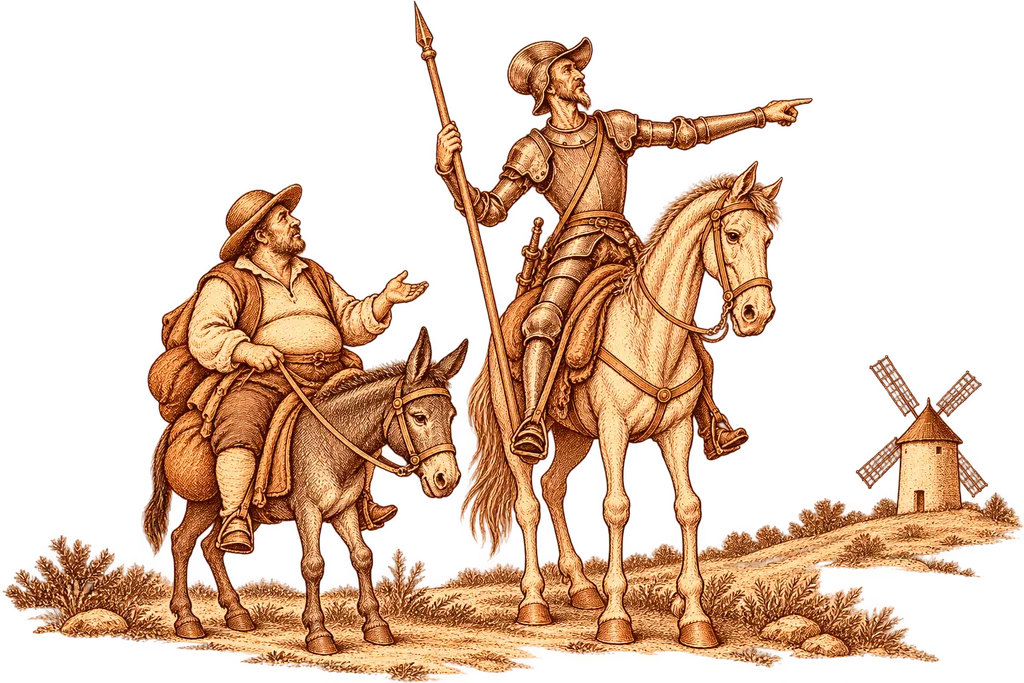
In I.8 Don Quixote treats windmills as giants despite Sancho’s warning. In II.10 Sancho invents an account of Dulcinea around a group of peasant women. The first involves a conviction resistant to evidence; the second involves a statement constructed for someone else. Comparison distinguishes error, deception and imaginative response.
Ask what could make a character revise an interpretation. When enchantment explains every possible outcome, a belief may survive even the failure of the action it inspired.
Narration and competing accounts
I.9 makes the search for the story part of the story. Arabic papers appear, along with someone who translates them. The account attributed to Cide Hamete Benengeli reaches readers through several voices. Cervantes, the historical author, should be distinguished from the figures presenting and commenting on events within his fiction.
This structure prompts questions about where an account comes from and what reservations accompany it. It does not make every event indistinguishable from every other event; it supplies clues for assessing how a version is produced.
Freedom, desire and responsibility
In I.14 Marcela answers people who blame her for Grisóstomo’s suffering. Her defense separates another person’s desire from her own obligation. Readers may connect the episode with present-day questions of autonomy while recognizing that this connection is a current interpretation and examining the scene’s pastoral setting.
Sancho raises a different question of freedom in II.53. He leaves government after experiencing its restrictions and humiliations. The position he once desired matters less than recovering his life. Comparing the scenes prevents “freedom” from becoming a single undifferentiated slogan.
Humor and power
A joke may arise from the gap between Don Quixote’s interpretation and what readers recognize. It may also be arranged through authority and resources to subject someone else to an experience. Barataria provides a contrast: An organized trick contains judgments by Sancho that can be assessed on their own merits.
Ask who understands the performance, who can stop it and who bears its cost. This distinguishes a character’s laughter from automatic approval by the novel.
Reputation and control of identity
In II.3 the travelers discover their story in print. In II.59 they meet a competing continuation. Books are no longer only models from the past: They affect the travelers’ current reputation. Our reading is that the novel explores how a circulating image can restrict a person beyond their control.
How to explore these themes
Choose one of these themes and an episode that illustrates it. Make a claim another reader could dispute, identify the event supporting it and consider a detail that complicates it. A seemingly contradictory scene can refine your argument’s scope. Avoid diagnosing the protagonist medically or assigning Cervantes a modern position without evidence.
Use the chapter index for individual scenes. The reading guide offers a simple note-taking method.