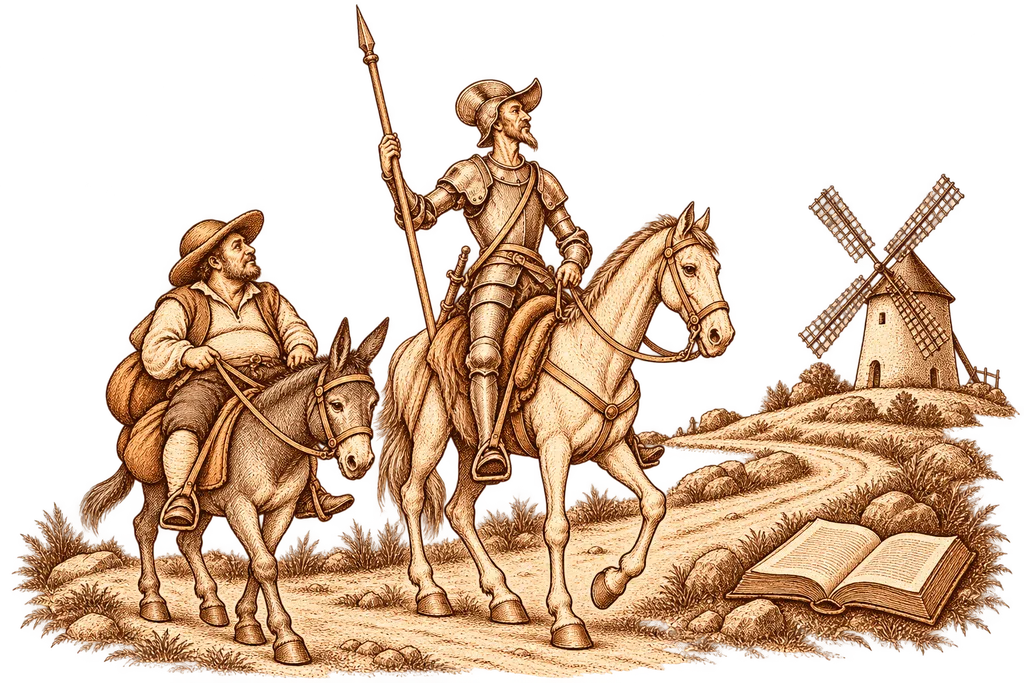
This Don Quixote summary follows the adventures of a country gentleman who decides to become a knight errant after accepting books of chivalry as true accounts. Sancho Panza joins him on his second journey. Their adventures reveal how the two companions defend their beliefs, face disappointment and come to care for each other.
On this page
Spoiler notice: This summary includes the ending. To discover events as you read, use the chapter index after each chapter.
Summary of Part 1
The protagonist cleans old armor, names his horse Rocinante and calls himself Don Quixote of La Mancha. He also needs a lady to serve. He turns Aldonza Lorenzo, a woman from his region, into Dulcinea del Toboso. Naming is part of the identity he constructs to enter the world of his books. His first journey is solitary. He returns battered, and members of his household try to remove the influence of his reading.
In I.7 he persuades his neighbor Sancho Panza to become his squire by promising him a governorship. Their second journey establishes the novel’s central relationship. Don Quixote seeks chivalric honor; Sancho thinks about food, money and his family’s future. Both, however, are drawn to the prospect of a different life.
The windmills in I.8 make their disagreement visible. Sancho sees machines, while Don Quixote sees giants and charges. Defeat does not end his conviction: Enchantment gives him a way to explain the evidence against it. Readers can examine both the mistake and the reasoning that preserves it.
The road also brings other people’s stories into the novel. In I.14 Marcela argues that her beauty and another person’s desire do not oblige her to return his love. In the Sierra Morena, Don Quixote deliberately imitates the penance of literary heroes. His imagined world sometimes involves misperception, but it can also be a performance he consciously chooses.
Part 1 ends with his return home. This concludes the journey without conclusively ending the possibility of another one. The return should therefore be distinguished from the ending of the complete novel.
Summary of Part 2
Part 2 changes the circumstances of the adventure. Don Quixote and Sancho learn that an account of their previous journeys has appeared in print. In II.3, Sansón Carrasco discusses the book with them. Their reputation now helps shape their encounters: People can recognize them and arrange situations around the behavior they expect.
Dulcinea becomes a shared problem in a new way. In II.10 Sancho presents a group of peasant women as if one were the lady. Don Quixote sees something that does not match his ideal and explains the difference through enchantment. The squire has helped create an account that will affect both men afterward.
Sancho eventually governs Barataria. His judgments in II.45 show an ability to listen and solve disputes. Although the governorship is arranged as a trick, his decisions can still have substance. After a staged attack, he gives up the office in II.53 and chooses his freedom. A reward he once imagined becomes an experience through which he can reconsider his wishes.
In II.59 the travelers encounter a competing printed account: The continuation attributed to Avellaneda. They respond to a portrayal they regard as false. The dispute over who may tell their story becomes part of the story itself.
The return and the ending
In Barcelona, the Knight of the White Moon defeats Don Quixote. The terms of the contest require him to return to his village and give up knight errantry for a time. At home, he falls ill and regains his judgment. In II.74 he identifies himself as Alonso Quijano, rejects the books of chivalry, makes his will and dies.
Sancho urges him to live and suggests the pastoral life they had imagined. The companion originally tempted by advancement now struggles with the prospect of losing his friend. Our reading is that this emotional change prevents the ending from becoming a simple triumph of common sense.
Continue with the character guide, themes and analysis, or the indexes for Part 1 and Part 2.
Sources for checking this page
- Cervantes, Don Quijote, I,1
- Cervantes, Don Quijote, I,7
- Cervantes, Don Quijote, I,8
- Cervantes, Don Quijote, I,14
- Cervantes, Don Quijote, I,25
- Cervantes, Don Quijote, I,52
- Cervantes, Don Quijote, II,3
- Cervantes, Don Quijote, II,10
- Cervantes, Don Quijote, II,45
- Cervantes, Don Quijote, II,53
- Cervantes, Don Quijote, II,59
- Cervantes, Don Quijote, II,64
- Cervantes, Don Quijote, II,74