Sancho takes office in Barataria and surprises his audience with three judgments. The cases allow us to distinguish ingenuity, observation, and the limits of an apparently decisive test.
On this page
Characters and setting
Characters: Sancho; the steward; the tailor; the countryman; two elderly men; the woman bringing a complaint; the cattle farmer; the recorder of the governor’s actions. Setting: Barataria, a town belonging to the duke; the place of judgment.
Summary
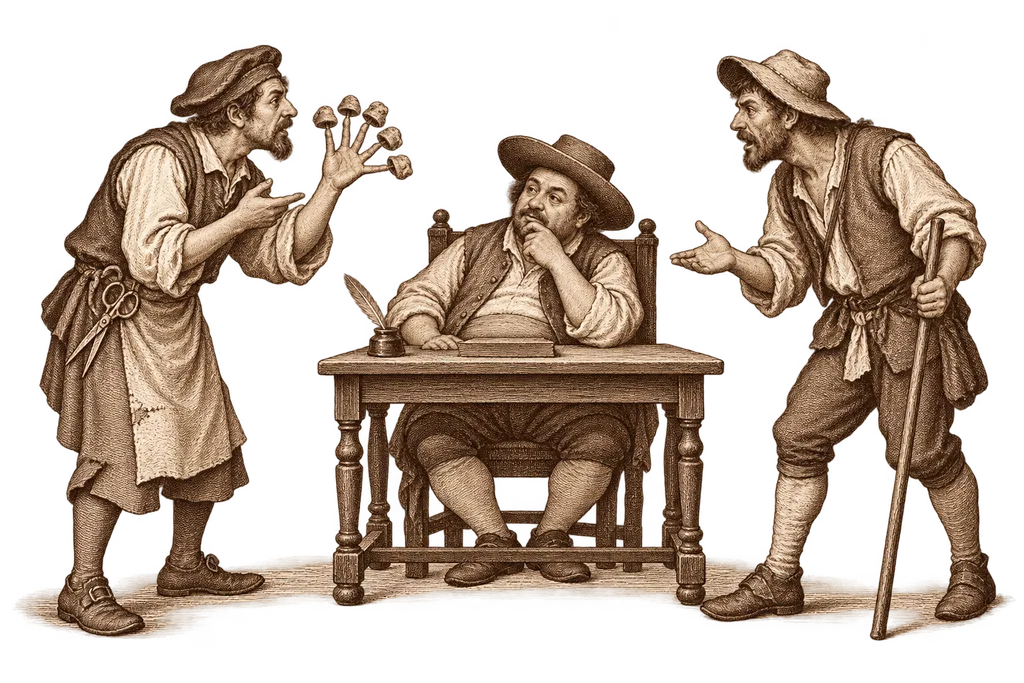
Barataria is a town in the duke’s territory presented to Sancho as an island. He rejects the title Don. In a dispute over five tiny caps, he rules that the tailor lose his labor and the customer his cloth.
He next finds ten gold coins hidden in a cane: The debtor handed it to the creditor while swearing that he had returned the money. In the third case, a woman accuses a livestock dealer of forcing her sexually. Sancho gives her the man’s purse and orders him to retrieve it. When she successfully keeps it, the governor dismisses her accusation and banishes her. This inference equates different situations: Defending a purse does not establish consent to an earlier sexual encounter.
What to Notice
The cane case combines observed gestures with spoken words. Sancho also recalls hearing a similar story from his village priest. The spectators and chronicler move from expecting entertainment to wondering whether their governor possesses real judgment.
Analysis
We resist treating all three decisions as equal demonstrations of wisdom. The cane provides physical confirmation of a deception; the third case rests on an inference about the woman’s behavior. The audience’s admiration is a narrative fact, not a requirement that readers approve every method. Ingenuity in a story and reliability in reasoning can be evaluated separately.
Reading It Today
Original reflection: A test may be persuasive because it reproduces a visible action while failing to establish what happened in a different setting. The purse episode asks us to consider what a demonstration actually proves. Reading it today means preserving the events of the text while identifying the inference’s limits, rather than treating spectators’ applause as a guarantee of justice.
Sources and Text
Miguel de Cervantes, Don Quijote de la Mancha, Part 2, Chapter 45. Francisco Rodríguez Marín edition, Madrid, La Lectura, 1911–1913, volume 7. Facsimile passages consulted: P. 155; p. 161; p. 166. Chapter text at the Centro Virtual Cervantes.


