An inn gives Don Quixote an adventure created by reading. He meets readers of a rival continuation of his exploits and changes his journey to contradict it.
On this page
Characters and setting
Characters: Don Quixote; Sancho Panza; the innkeeper; Don Juan; Don Jerónimo. Setting: A spring beside the road; an inn.
Summary
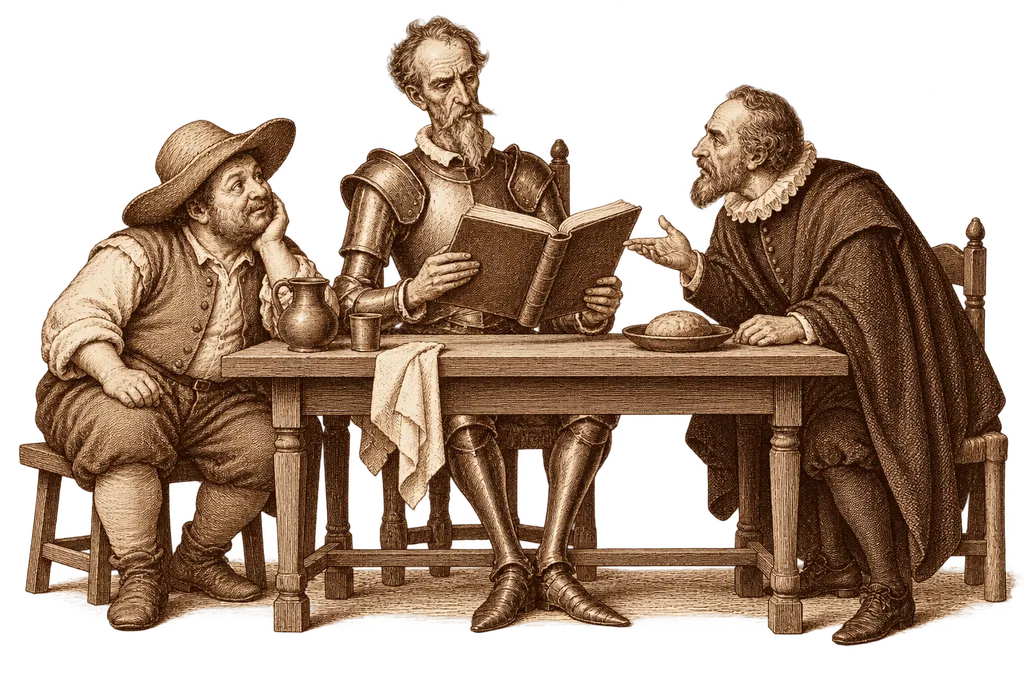
After the cattle incident, Sancho encourages his master to eat and rest. They reach an inn that Don Quixote recognizes as an inn. During dinner he hears Don Juan and Don Jerónimo discussing another second part, Avellaneda’s. He protests against its claim that he has forgotten Dulcinea and briefly examines the book.
The readers speak with the protagonists and accept that they differ from the figures in the rival account. Learning that the other Don Quixote went to Zaragoza, the knight decides to avoid that city and travel to Barcelona. Sancho pays the innkeeper, and they continue their journey.
What to Notice
Don Quixote does not read the entire book he rejects. His complaint about the name of Sancho’s wife is also imperfect evidence: Cervantes’s own narrative had used Mari Gutiérrez before settling on Teresa Panza.
Analysis
The inn is recognized as an inn, a small detail that changes the reader’s expectations. Don Quixote need not misidentify every object to remain the same character. His judgment depends on the subject: He understands where he will dine, then passionately defends fidelity to Dulcinea when he hears that another book denies it.
Don Juan and Don Jerónimo bring reading into the action. The protagonist encounters more than people acquainted with his earlier history: He confronts a continuation that uses his name differently. Conversation with knight and squire lets these readers compare living visitors with printed versions. The dispute about representation produces a meeting, a supper and altered plans, rather than remaining a narrator’s declaration.
Avoiding Zaragoza makes the itinerary an argument. If the other Don Quixote went there, traveling to Barcelona will distinguish this one. His freedom contains a paradox: The rejected work influences precisely the route chosen to contradict it. Notice the qualities each companion defends. Constancy in love matters to the knight; Sancho also demands a different account of his speech and habits. Identity becomes something contested before readers capable of comparing versions.
Reading It Today
Someone else’s description can shape our behavior even when we want to refute it. Don Quixote chooses another destination to distinguish himself from his printed double. The scene invites reflection on reputation and decisions made in response to stories about us. Defending an identity may matter, but it helps to notice when that defense gives others the power to direct our choices.
Sources and Text
Miguel de Cervantes, Don Quijote de la Mancha, Part 2, Chapter 59. Francisco Rodríguez Marín edition, Madrid, La Lectura, 1911–1913, volume 8. Facsimile passages consulted: P. 84; p. 86; p. 93; p. 94. Chapter text at the Centro Virtual Cervantes.
Read the chapter in English. Read Part 2, Chapter 59 in English in John Ormsby’s translation, via Project Gutenberg. Compare it with the Spanish source cited above; our summary and commentary are separate from the translation.