The duke and duchess turn their courtyard into a funeral spectacle. Sancho faces another demand for suffering to remedy a misfortune he did not cause.
On this page
Characters and setting
Characters: Don Quixote; Sancho Panza; Altisidora; the duke and duchess; performers playing Minos and Rhadamanthus; musicians and servants. Setting: The duke and duchess’s courtyard, arranged as a funeral stage.
Summary
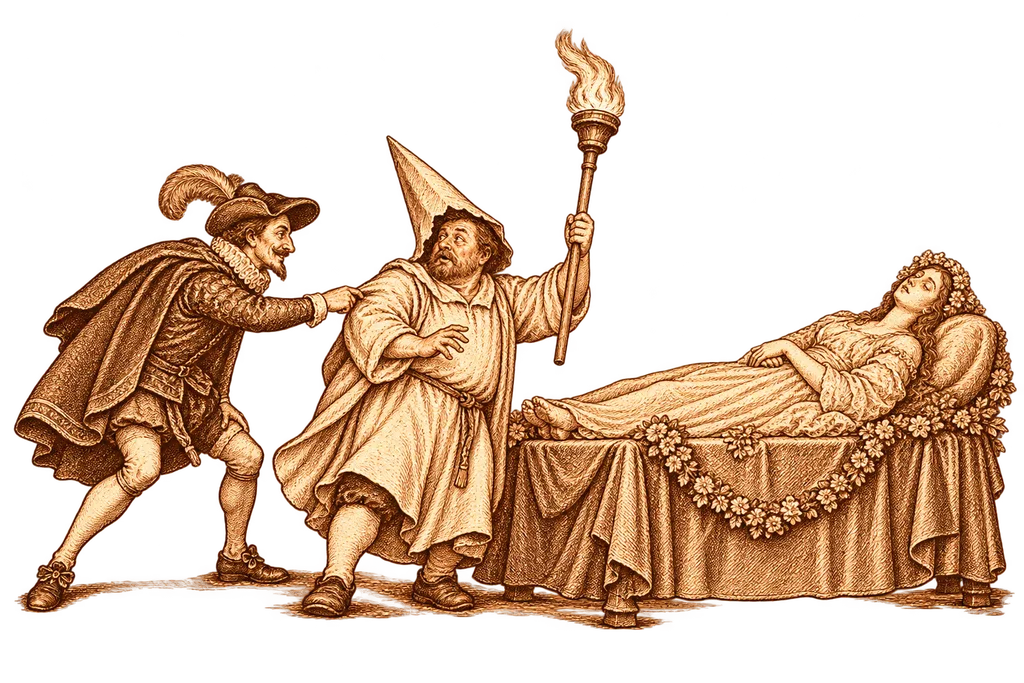
The travelers are brought before an illuminated bier where Altisidora pretends to be dead. The duke and duchess watch beside figures dressed as Minos and Rhadamanthus. Sancho receives a flame-covered garment and a pointed cap and is ordered to remain silent. The performers announce that Altisidora will revive if his face is handled roughly, his body pinched and his flesh pricked with pins. Sancho protests that his body has no connection with this supposed cure. Don Quixote urges patience. The squire submits to the handling and pinching, but rises when the pins arrive and threatens his tormentors with a torch. Altisidora moves and everyone celebrates her return to life. Don Quixote asks Sancho to use the occasion for Dulcinea’s lashes; he refuses. Altisidora promises shirts as a reward.
What to notice
The narrative itself suggests that Altisidora moves because she is tired of lying still: The scene does not establish a real resurrection. Sancho’s suffering is real.
Analysis
Lighting, costume, music and authoritative figures give credibility to an imposed ceremony. Sancho recognizes the remedy’s lack of foundation, but threats and deference make him yield. A promised reward does not erase coercion. Don Quixote reads the performance as proof of his squire’s healing power.
A reflection for today
Promising a benefit to others does not justify demanding pain from someone who has not chosen it. The chapter shows how solemn language can frame abuse as ceremony. Sancho’s protest reminds us that a person’s body is not a resource for spectators to use.
Sources and edition
This guide uses Cervantes’s text in Francisco Rodríguez Marín’s La Lectura edition (1911–1913), volume 8, II.69. Verifiable locator: Identifier donquijotedelama08cerv, scan images 252–265 (zero-based digital index). The heading and selected passages were visually checked; the complete notes were not collated. Analysis and present-day reflection are this guide’s commentary.

