The road to Barcelona brings violence that requires no enchanters. Don Quixote meets a bandit capable of measured reasoning and sudden cruelty.
On this page
Characters and setting
Characters: Don Quixote; Sancho Panza; Roque Guinart and his bandits; Claudia Jerónima; Vicente; travelers and pilgrims. Setting: The road toward Barcelona and the area where Roque’s band operates.
Summary
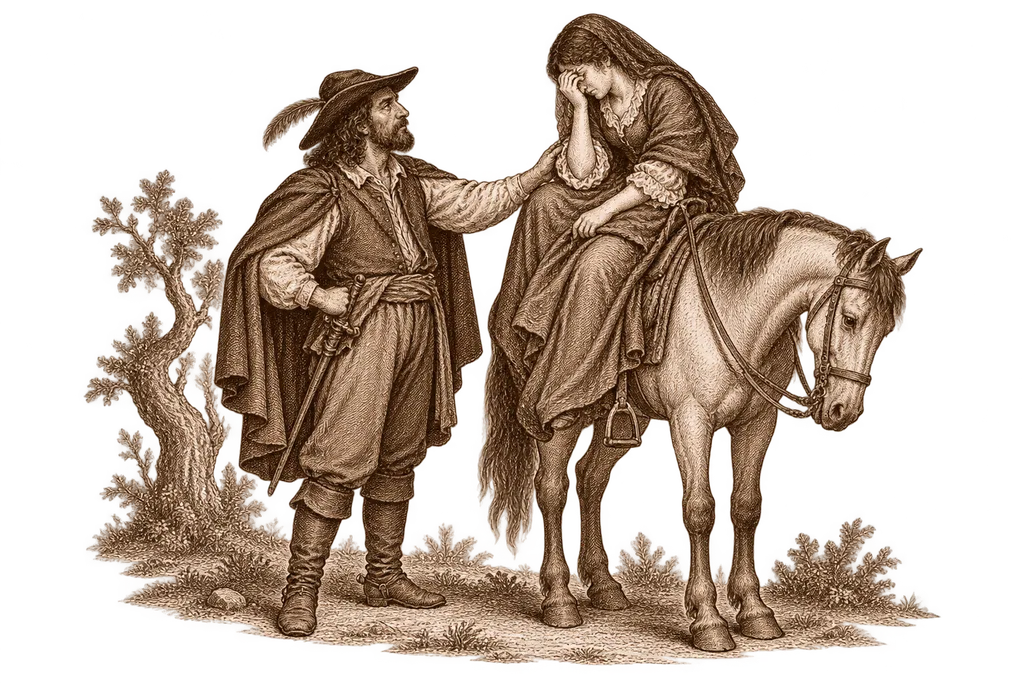
Don Quixote tries to whip the sleeping Sancho to release Dulcinea from enchantment. Sancho throws him down and demands that the lashes remain voluntary. After discovering hanged bandits, they are surrounded by a living band. Its leader, Roque Guinart, stops Sancho being robbed. Claudia Jerónima arrives after shooting Vicente because she believed he was marrying someone else. Roque accompanies her: Vicente denies the report, accepts her as his wife and dies. Claudia decides to enter a convent. Roque distributes stolen goods fairly, takes some money from other travelers and helps pilgrims and Sancho; he then fatally wounds a subordinate who criticizes his generosity. He writes to a friend in Barcelona announcing the knight’s arrival.
What to notice
Sancho physically defends his own choice. Claudia’s story changes when Vicente denies the report. Roque’s fairness in distributing loot coexists with violence against dissent.
Analysis
Roque’s courtesy does not remove robbery or coercion. His account of accumulating revenge shows self-awareness rather than completed reform. Don Quixote urges repentance and offers knighthood as a remedy, although the events exceed that framework. Claudia reveals the irreversible damage of acting before listening.
A reflection for today
An orderly distribution can conceal an abusive origin. The chapter encourages us to examine both a procedure and the source of what it distributes. Claudia’s tragedy also raises the danger of treating an unchecked report as sufficient certainty for an irreversible decision.
Sources and edition
This guide uses Cervantes’s text in Francisco Rodríguez Marín’s La Lectura edition (1911–1913), volume 8, II.60. Verifiable locator: Identifier donquijotedelama08cerv, scan images 100–126 (zero-based digital index). The heading and selected passages were visually checked; the complete notes were not collated. Analysis and present-day reflection are this guide’s commentary.

