Sancho’s departure divides the narrative between two settings. Alone at the palace, Don Quixote worries about a torn stocking and the love he thinks he inspires in Altisidora.
On this page
Characters and setting
Characters: Sancho; Don Quixote; the duke and duchess; the steward; Altisidora; Emerencia. Setting: The ducal palace; the road to Barataria.
Summary
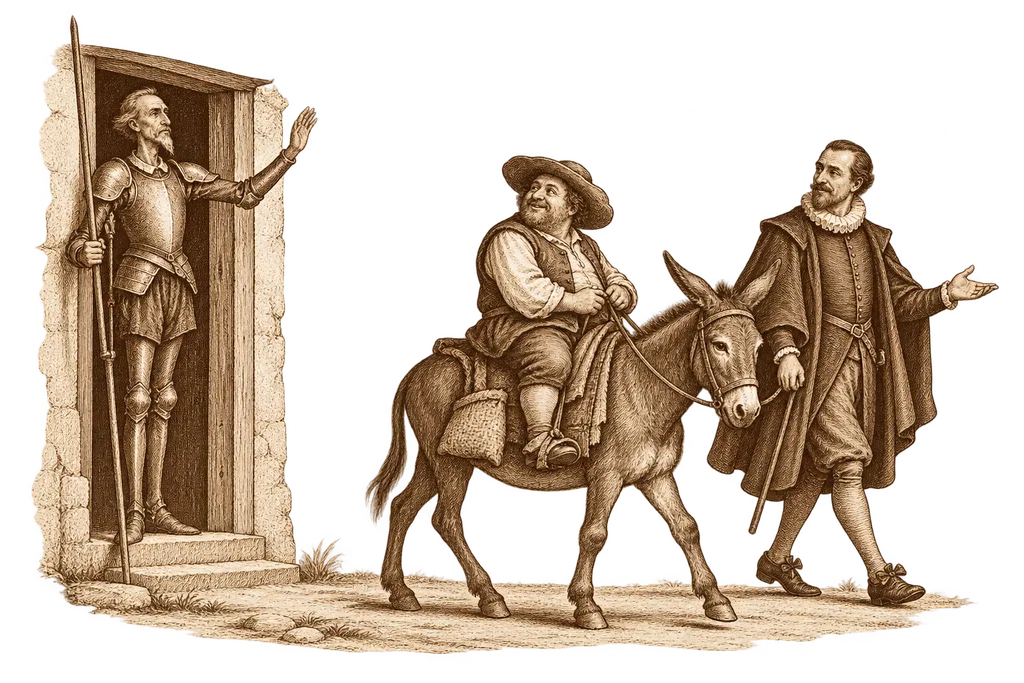
Cide Hamete explains why this second part avoids stories detached from its protagonists. Don Quixote’s written advice reaches the hosts. Sancho leaves with the steward, whose face and voice remind him of Trifaldi; his master avoids drawing the conclusion about the disguise.
Don Quixote misses his squire and refuses the maids’ assistance in his bedroom. Undressing reveals a torn stocking and prompts a digression on a poor gentleman’s need to preserve appearances. Altisidora sings a counterfeit declaration of love from the garden. The knight takes it seriously and renews his fidelity to Dulcinea.
What to Notice
The narrator discusses what the book omits just before it begins alternating the master’s and squire’s experiences. A stocking interrupts heroic dignity with a domestic shortage. The song’s promised clothing and presents also touch that material need.
Analysis
We see two vulnerabilities exploited by the palace: Emotional isolation and anxiety about appearances. Don Quixote resists the supposed seduction while accepting its premise that he is desired. Keeping faith with Dulcinea does not mean understanding his situation. The reflection on poverty is assigned to Benengeli’s narrative voice and should be distinguished from a direct statement by Cervantes.
Reading It Today
Original reflection: Someone may remain faithful to a principle while misunderstanding attention designed to amuse other people at their expense. Altisidora’s song encourages us to consider the circumstances behind a declaration. The stocking raises a different question: Which real needs stay hidden when a person tries to maintain an image of self-sufficiency?
Sources and Text
Miguel de Cervantes, Don Quijote de la Mancha, Part 2, Chapter 44. Francisco Rodríguez Marín edition, Madrid, La Lectura, 1911–1913, volume 7. Facsimile passages consulted: P. 134; p. 146. Chapter text at the Centro Virtual Cervantes.

