Don Quixote answers Altisidora’s supposed love with music. The hosts interrupt his declaration of fidelity with a practical joke that causes real injuries.
On this page
Characters and setting
Characters: Don Quixote; Altisidora; Emerencia; the duke and duchess; servants. Setting: Don Quixote’s room and the palace garden.
Summary
Altisidora pretends to faint before the knight. He requests an instrument and writes a ballad to discourage her, recommending work and modesty while declaring that Dulcinea already occupies his soul. The hosts arrange another amusement around his performance.
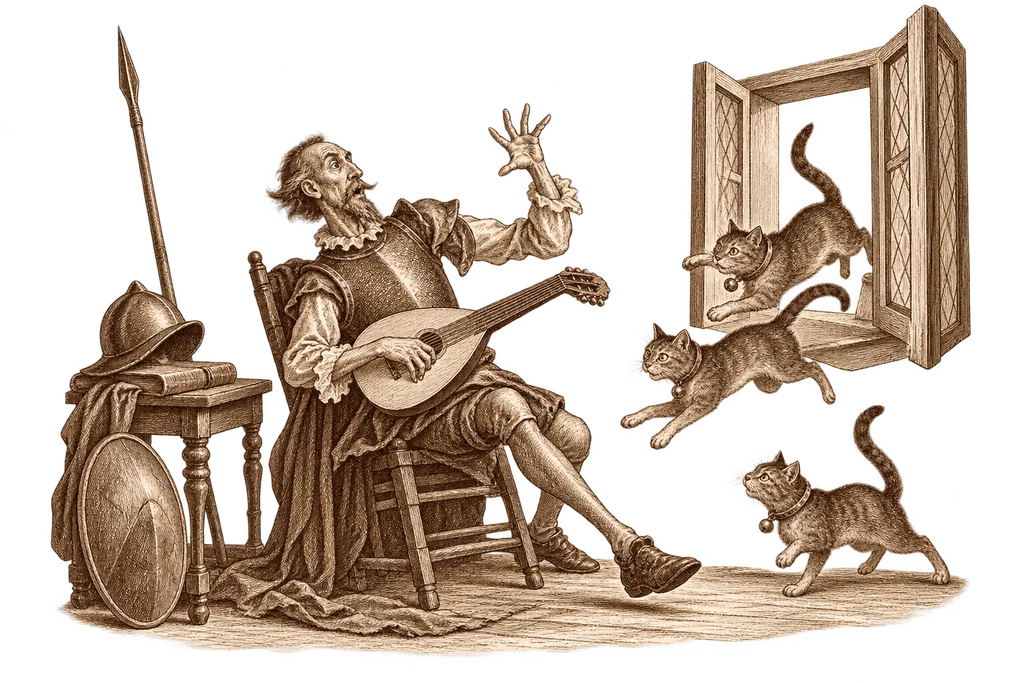
As he sings by the window, servants ring cowbells and release cats carrying smaller bells. Some enter the room. Don Quixote attacks with his sword, believing enchanters have assaulted him, and a cat clings to his face. The duke removes it. Altisidora treats the wounds while continuing her romantic reproaches. The hosts regret the damage, and the knight must recover in his room.
What to Notice
The announced intention to make an amusing joke is contradicted by its consequences. The frightened cats try to escape. The narrator’s account of their behavior contrasts with the supernatural enemies imagined by Don Quixote.
Analysis
We locate responsibility in those who arrange the situation even when they do not predict its exact outcome. Don Quixote’s gratitude creates a harsh irony: He thanks the people who caused the danger for protecting him. Their regret recognizes that the joke went too far, but it neither removes their involvement nor makes its harm harmless entertainment.
Reading It Today
Original reflection: Calling something a joke does not decide its effects in advance. Here the organizers take the role of rescuers after creating the risk. A comparison with a public prank today asks who controls the situation, who can stop it, and who has to absorb the consequences in order to preserve the relationship.
Sources and Text
Miguel de Cervantes, Don Quijote de la Mancha, Part 2, Chapter 46. Francisco Rodríguez Marín edition, Madrid, La Lectura, 1911–1913, volume 7. Facsimile passages consulted: P. 177. Chapter text at the Centro Virtual Cervantes.
