The promised island is no longer a distant hope. Before Sancho departs, Don Quixote advises him on character and the exercise of justice.
On this page
Characters and setting
Characters: Don Quixote; Sancho; the duke. Setting: A room in the ducal palace.
Summary
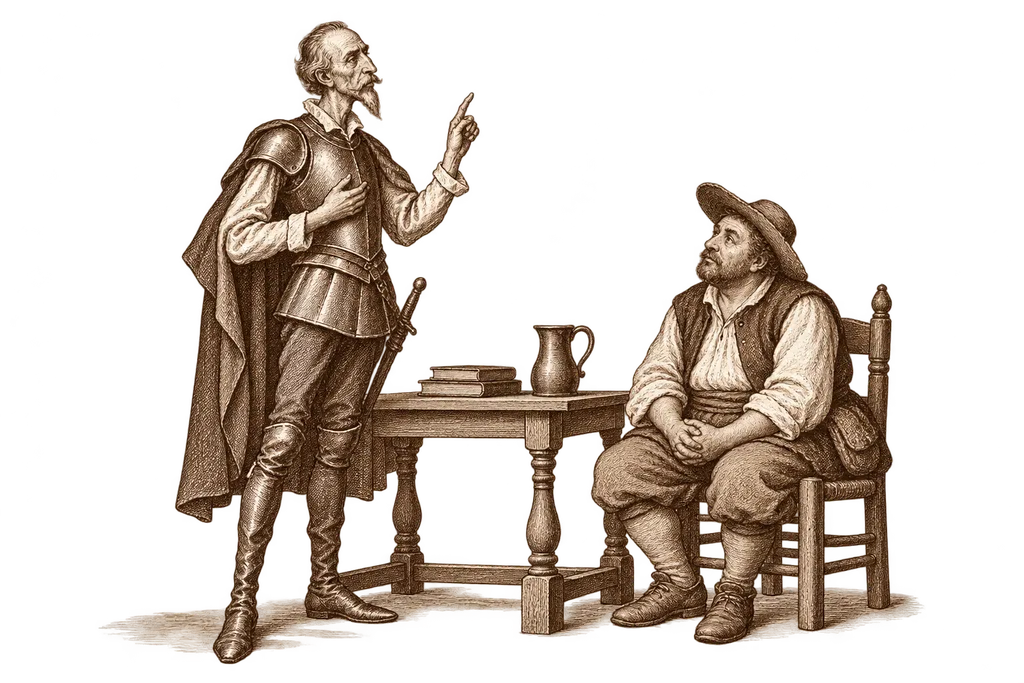
The duke arranges the governorship as another practical joke. Sancho says the supposed flight has diminished his ambition, though he remains curious about ruling. Don Quixote takes him aside and reminds him not to treat his appointment simply as proof of personal merit.
He recommends reverence for God, self-knowledge, and an unashamed acknowledgment of Sancho’s farming background. In disputes, Sancho must seek the truth without yielding to gifts, resentment, beauty, or emotional appeals. Compassion for the poor must not mean different justice. He should avoid insulting those he punishes and show mercy without wronging the opposing party.
What to Notice
The advice uses specific situations: Welcoming a humble relative, judging an enemy, or hearing a litigant’s tears. Social origins and treatment of others are connected to office rather than remaining abstract virtues.
Analysis
We read the pause as a demonstration of the knight’s judgment outside his chivalric obsession. His authority is also ironic: He does not know that the hosts are arranging the appointment for amusement. The preference for acquired virtue over inherited rank and for inquiry over appearances matters within that setting, but it does not turn every piece of advice into a consistent doctrine free from the period’s prejudices.
Reading It Today
Original reflection: Someone deciding a complaint needs to distinguish sympathy for a claimant from evidence about the case. Don Quixote separates compassion and justice while warning against gifts and personal grudges. In an association or workplace, explaining which facts informed a decision can protect both the person seeking help and the person answering the complaint.
Sources and Text
Miguel de Cervantes, Don Quijote de la Mancha, Part 2, Chapter 42. Francisco Rodríguez Marín edition, Madrid, La Lectura, 1911–1913, volume 7. Facsimile passages consulted: P. 102; p. 104. Chapter text at the Centro Virtual Cervantes.

