Clavileño lets the hosts stage a flight without leaving their garden. The episode ends with two accounts that neither protagonist can prove to the other.
On this page
Characters and setting
Characters: Don Quixote; Sancho; the duke and duchess; Trifaldi; servants. Setting: The ducal garden.
Summary
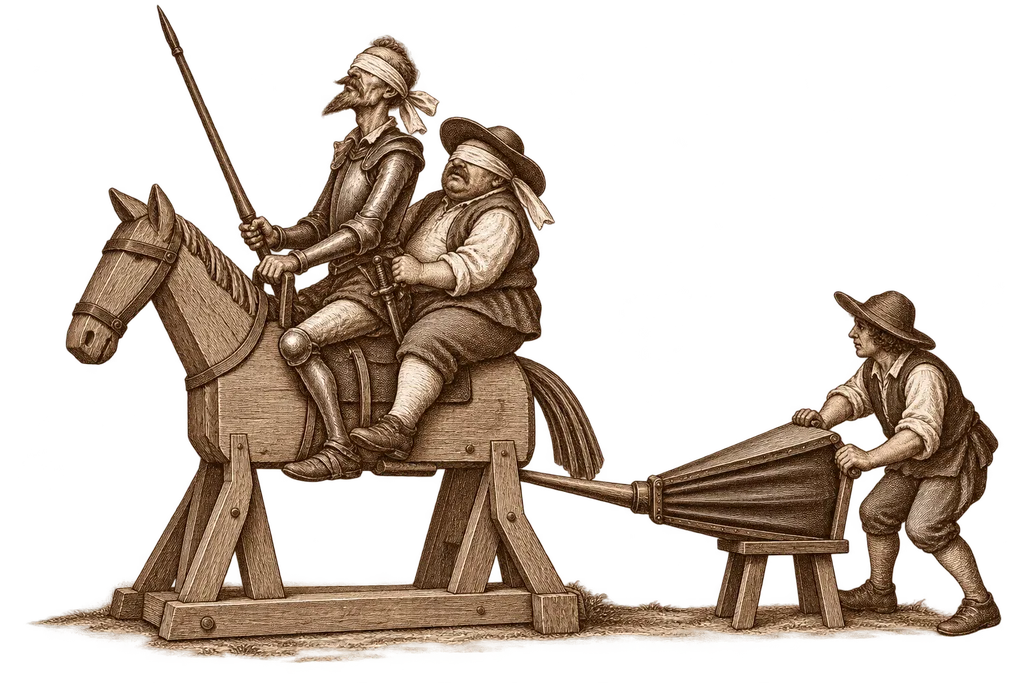
Servants bring the wooden horse and require its riders to be blindfolded. Sancho agrees after the duke connects the journey to his governorship. Don Quixote briefly considers examining the horse’s interior but drops the precaution.
Spectators announce the ascent, bellows supply wind, and burning tow produces heat. The hosts finally ignite fireworks inside the horse, throwing both riders to the ground. A notice declares the adventure complete. Sancho then claims to have seen the earth and played with the seven heavenly goats. Don Quixote questions the account and proposes that Sancho believe his Cave of Montesinos story if he wants his own heavenly journey believed.
What to Notice
Nearby voices make Sancho question their supposed altitude, but Don Quixote explains away the discrepancy through enchantment. The narrator supplies the physical mechanisms of the trick. Readers’ knowledge and the riders’ experience therefore follow different tracks.
Analysis
We read the ending as a negotiation over credibility. Don Quixote does not confirm what Sancho says he saw; he offers an exchange between disputed narratives. Sancho’s invention can be understood as a way of taking control of the conversation, but the chapter neither establishes a real flight nor definitively explains his motives for maintaining the claim.
Reading It Today
Original reflection: An immersive experience can create convincing sensations through coordinated cues. Clavileño combines instructions, sound, air, and heat, with interpretation supplying the apparent journey. Comparing it with modern simulations helps distinguish experiencing a sensation from verifying its cause, without treating Cervantes’s scene as a technological prediction.
Sources and Text
Miguel de Cervantes, Don Quijote de la Mancha, Part 2, Chapter 41. Francisco Rodríguez Marín edition, Madrid, La Lectura, 1911–1913, volume 7. Facsimile passages consulted: P. 80; p. 81; p. 85; p. 92. Chapter text at the Centro Virtual Cervantes.


