The nighttime procession ends with a demand on Sancho’s body. Dulcinea’s supposed release depends on his accepting a painful task that everyone around him wants him to perform.
On this page
Characters and setting
Characters: Don Quixote; Sancho; the duke and duchess; a servant playing Merlin; a page playing Dulcinea. Setting: The duke’s woods.
Summary
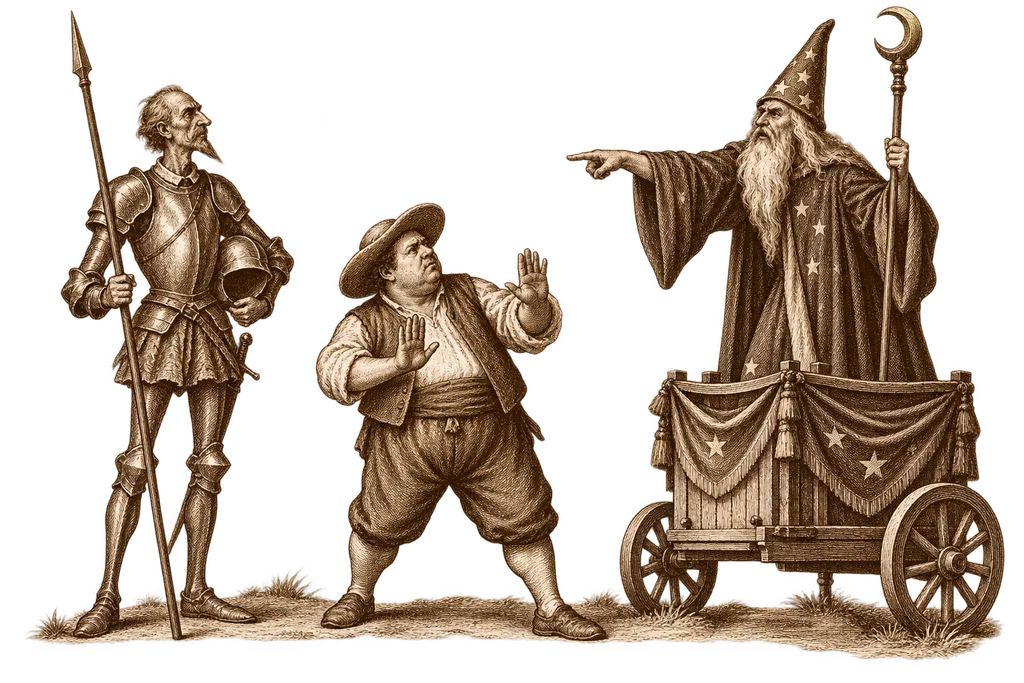
A triumphal cart carries performers appearing as Merlin and Dulcinea. Merlin declares that Sancho must give himself 3,300 lashes to end the enchantment. Sancho refuses. Don Quixote threatens to whip him, but Merlin insists that the lashes must be voluntary.
The counterfeit Dulcinea insults Sancho while asking for compassion. The duke makes the governorship depend on his agreement. Sancho notices inconsistencies in the message and objects to the way everyone asks for his sacrifice. He finally accepts on conditions: He chooses the timing, need not draw blood, and may count lighter blows. Don Quixote embraces him, and the delighted hosts return to their palace.
What to Notice
Merlin’s elevated verse ends in an exact number of blows. The gap between solemn presentation and Sancho’s bodily concerns drives the comedy. Meanwhile, the insistence on willingness sits beside threats, insults, and the possible loss of the governorship.
Analysis
Sancho’s terms preserve some control over timing and severity, but the agreement is extracted under pressure. Our reading distinguishes an announced choice from the practical freedom to refuse. Don Quixote’s embrace also matters: His gratitude is sincere even though the supposed need for sacrifice comes from a performance. A false cause can produce real emotions and consequences.
Reading It Today
Original reflection: A request changes when saying no means losing an opportunity or facing the entire group’s disapproval. Sancho’s bargaining draws attention to the actual conditions behind an agreement. This modern comparison does not attribute a contemporary theory of consent to Cervantes; it begins with the pressures explicitly staged in the chapter.
Sources and Text
Miguel de Cervantes, Don Quijote de la Mancha, Part 2, Chapter 35. Francisco Rodríguez Marín edition, Madrid, La Lectura, 1911–1913, volume 6. Facsimile passages consulted: P. 328; p. 329; p. 338. Chapter text at the Centro Virtual Cervantes.


