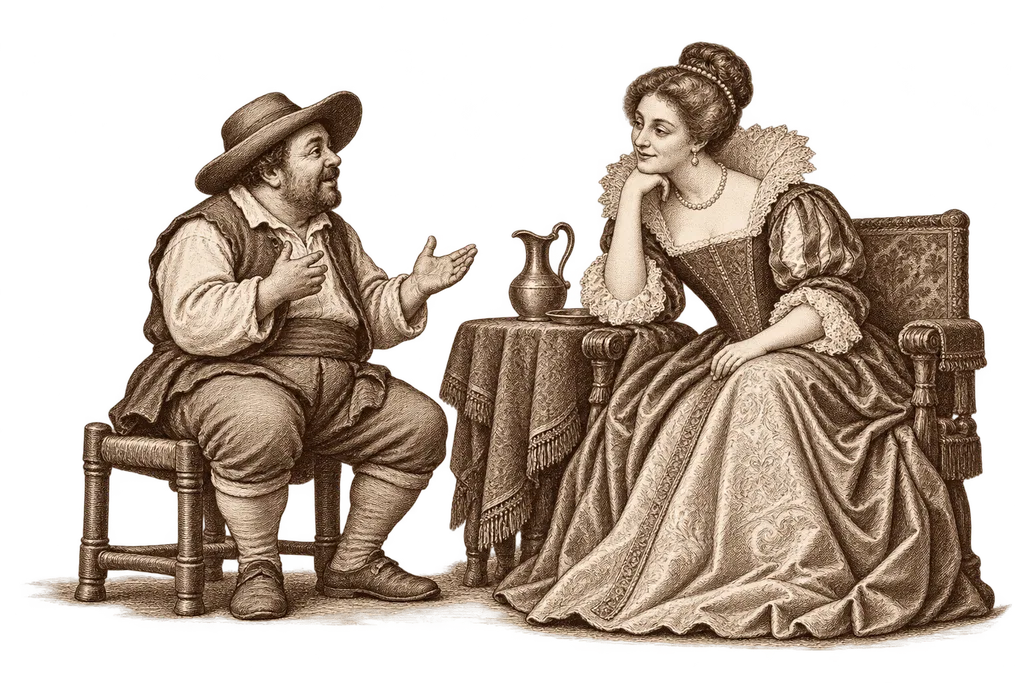
Sancho’s conversation with the duchess tests two convictions: He knows that his master is deluded, and he thinks he knows who invented Dulcinea’s enchantment. His hostess undermines the second conviction while exploiting the first.
On this page
Characters and setting
Characters: Sancho Panza; the duchess; Doña Rodríguez; the duchess’s young attendants. Setting: The duke and duchess’s palace.
Summary
The duchess asks how Sancho could describe Dulcinea’s response to a letter he never delivered. He admits inventing the visit and also explains the trick involving the three peasant women. Although he considers Don Quixote mad, he stays with him out of affection, gratitude, and loyalty. Losing the promised governorship might even be better for his conscience.
The duchess then insists that the peasant woman really was the enchanted Dulcinea: Enchanters deceived Sancho himself. He begins to accept her explanation and connects it to the Cave of Montesinos. His concern for his donkey, a disagreement with Doña Rodríguez, and a joke about governors entertain his hostess. She reports the conversation to the duke, and they plan a new deception.
What to Notice
Sancho checks behind the curtains for hidden listeners while several women openly listen. The promised privacy is already a performance. His account of loyalty also complicates the idea that he follows his master only for profit: He defends their bond while acknowledging that the governorship could be withheld.
Analysis
The duchess turns a confession into a means of controlling its speaker. Her status and claimed access to enchanters override Sancho’s memory of arranging the trick. We read this as a scene about unequal authority producing uncertainty. It does not establish that Sancho is foolish in every situation: His judgment of his master and his concern about the moral costs of office are notably clear.
Reading It Today
Original reflection: When a prestigious person explains your own experience back to you, distinguish what you remember from what you are being told. Sancho knows his part in the deception, yet the prospect of promotion and the palace’s reassuring manners make another version attractive. A useful question is who benefits from changing the account.
Sources and Text
Miguel de Cervantes, Don Quijote de la Mancha, Part 2, Chapter 33. Francisco Rodríguez Marín edition, Madrid, La Lectura, 1911–1913, volume 6. Facsimile passages consulted: P. 291; p. 298. Chapter text at the Centro Virtual Cervantes.

