Don Quixote asks for respect after a public rebuke. The hosts continue their game, promise Sancho a governorship and enjoy ceremonies their guests struggle to interpret.
On this page
Characters and setting
Characters: Don Quixote, Sancho, the duke, the duchess, the cleric, the serving women and the servants. Setting: The ducal castle following the cleric’s rebuke.
Summary
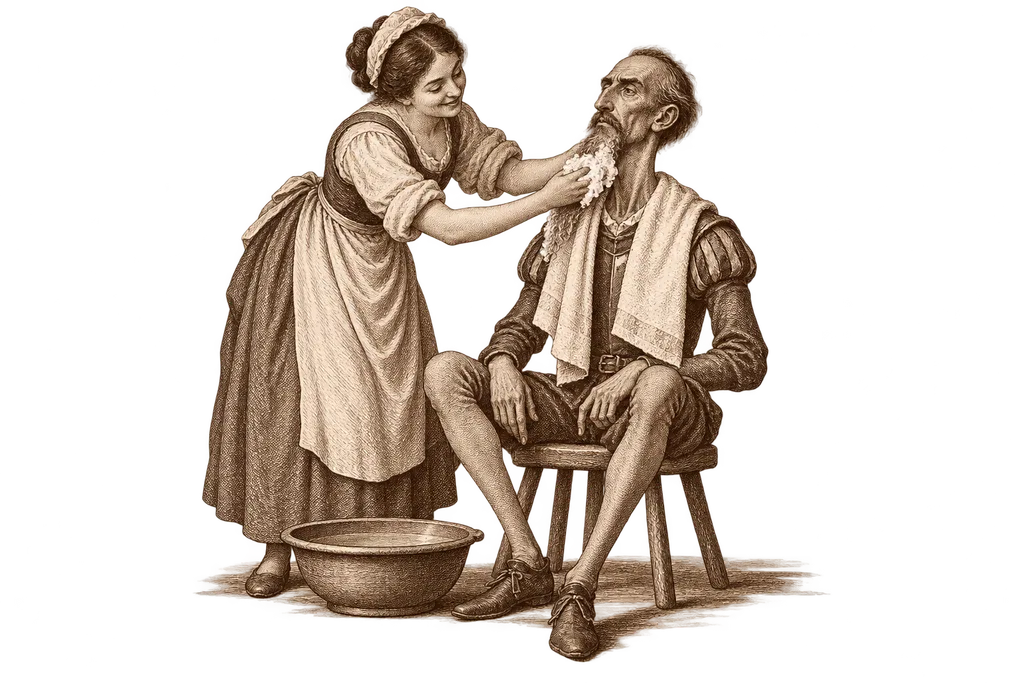
Don Quixote tells the cleric that correction should not become insult and defends his chivalric aims. The duke promises Sancho an island, and the cleric leaves the table. Serving women wash and soap Don Quixote's beard as a trick. To conceal it, the duke undergoes the same treatment. The hosts then question Dulcinea's existence and lineage; Don Quixote defends his ideal and explains contradictions through enchanters. Sancho returns pursued by servants wanting to wash him with dirty water. He protests, Don Quixote supports him, and the duchess orders them to stop.
What to notice
The serving women initiate the first washing trick; the hosts had not planned it. Their response then incorporates it into the entertainment and conceals it from Don Quixote.
Analysis
Don Quixote distinguishes correction from insult when answering the cleric. Respect for him can be claimed without accepting every assertion in his chivalric defense. The chapter keeps these questions together: A weak belief does not make every way of treating its holder just. Meanwhile, the promise of an island for Sancho renews the visitors’ interest in remaining where they appear to receive recognition and reward.
Washing the knight’s beard introduces a trick initiated by the serving women, which the duke conceals by submitting to the same gesture. Formally sharing the treatment does not remove the difference between the person unaware of the deception and the person attempting to sustain it. Questions about Dulcinea explore this unequal information again under the appearance of courteous curiosity. Sancho subsequently establishes a material boundary by rejecting dirty water. His protest compares the treatment’s quality rather than merely its ceremonial name. Don Quixote supports him, and the duchess stops it. Notice who can call a practice customary and who must experience its effects. The squire’s refusal allows supposed hospitality to be judged through what it does to the body required to receive it, rather than through the hosts’ description alone.
A reflection for today
A group practice deserves examination when it humiliates the person subjected to it. Sancho's protest asks whether an alleged tradition offers care or makes someone a spectacle, and encourages support for their right to refuse it.
Sources and edition
This guide uses Cervantes’s text in Francisco Rodríguez Marín’s La Lectura edition (1911–1913), volume 6, II.32. Verifiable locator: Identifier donquijotedelama06cerv, scan images 258–289 (zero-based digital index). The heading and selected passages were visually checked; the complete notes were not collated. Analysis and present-day reflection are this guide’s commentary.
Read the chapter in English. Read Part 2, Chapter 32 in English in John Ormsby’s translation, via Project Gutenberg. Compare it with the Spanish source cited above; our summary and commentary are separate from the translation.