An empty boat seems to Don Quixote a means provided for a mission. The Ebro's current carries him towards watermills that he interprets as a prison.
On this page
Characters and setting
Characters: Don Quixote, Sancho, the millers and the boat’s owners. Setting: The River Ebro beside the watermills.
Summary
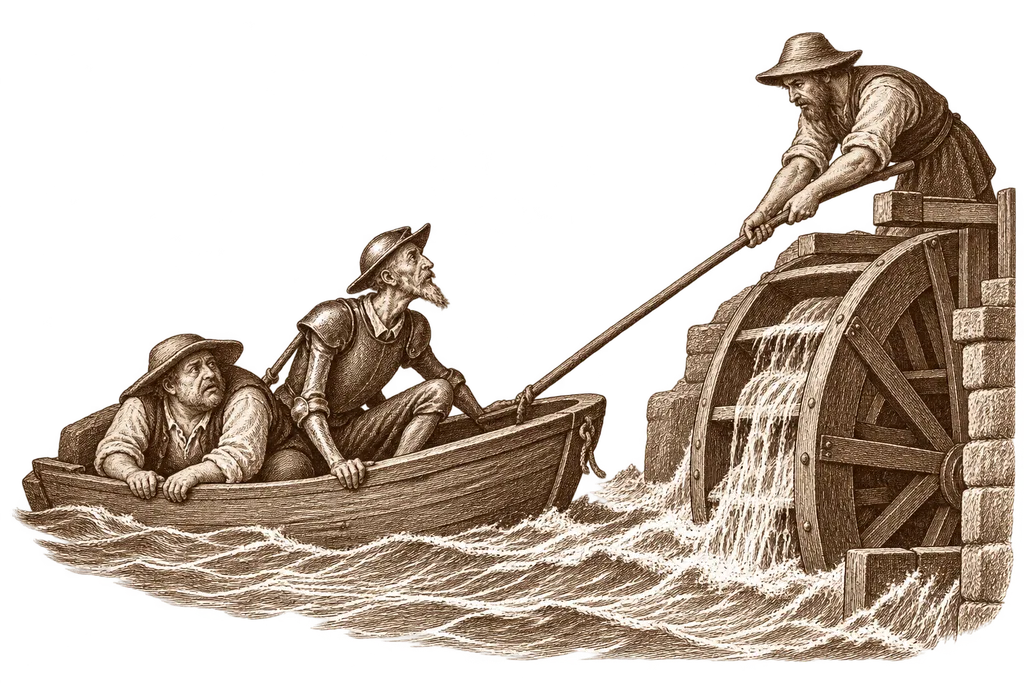
Don Quixote finds a small boat tied to the bank, leaves the animals ashore and boards with Sancho. He believes it must carry them to rescue someone and calculates enormous distances, although Sancho can still see their starting point. Approaching the watermills, the knight mistakes them for a fortress and threatens the millers. They try to keep the boat from entering the wheels. The travelers fall into the water and the millers rescue them; the boat is destroyed. Don Quixote continues asking for imagined prisoners but eventually pays the owners and returns to the animals.
What to notice
The narrator attributes the movement to the river's current, without a hidden enchanter. The supposed opponents are the people who save the travelers.
Analysis
The adventure reverses the rescuer's role Don Quixote assigns himself. Treating assistance as opposition obstructs his and Sancho's rescue. The squire's observed distance also contrasts with an elaborate geographical explanation unsuited to the situation.
A reflection for today
A complicated account may override a simple observation when vocabulary is mistaken for proof. Sancho encourages retaining verifiable reference points; the millers also suggest recognizing help from someone we had classified as an enemy.
Sources and edition
This guide uses Cervantes’s text in Francisco Rodríguez Marín’s La Lectura edition (1911–1913), volume 6, II.29. Verifiable locator: Identifier donquijotedelama06cerv, scan images 208–222 (zero-based digital index). The heading and selected passages were visually checked; the complete notes were not collated. Analysis and present-day reflection are this guide’s commentary.

