The travelers meet aristocrats who already know them from the book of their adventures. Fame allows readers to become organizers of their protagonists' lives.
On this page
Characters and setting
Characters: Don Quixote, Sancho, the duke, the duchess and their companions. Setting: The place where they meet the hunting party and the road to the ducal castle.
Summary
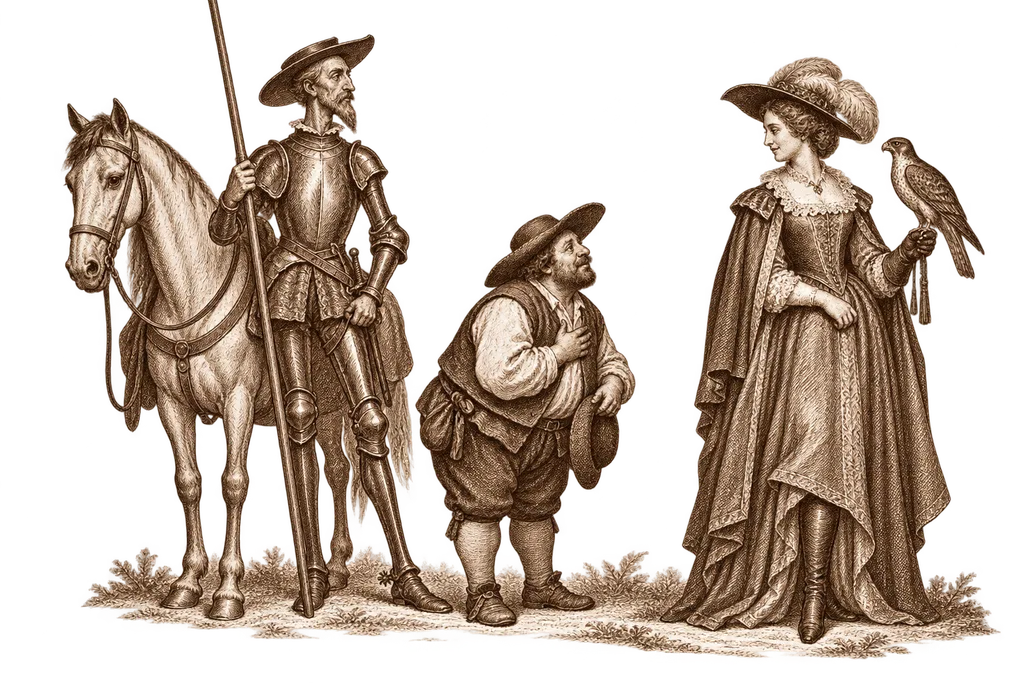
After the river disaster, Don Quixote sees a hunting party and sends Sancho to a lady carrying a hawk. The duchess recognizes knight and squire from their printed history and invites them to the home she shares with the duke. The couple decides to receive them according to the ceremonies of chivalric books. When they try to dismount, Sancho gets caught and Don Quixote falls with his loose saddle. Their hosts help and continue their courteous reception. The duchess enjoys Sancho's conversation as they all head to the castle.
What to notice
Readers learn the hosts' purpose before the guests do. Their welcome follows a decision to indulge the travelers and stage a knightly experience.
Analysis
The hawk and hunting party allow Don Quixote to identify a social position that really exists. This encounter does not begin by turning a peasant into a noblewoman; he actually addresses a duchess. The unequal information lies elsewhere. She and the duke know the travelers through the printed book and arrange their welcome accordingly. Their guests can mistake this prepared conduct for spontaneous confirmation of their own importance.
Dismounting mishaps expose bodies beneath ceremony. Sancho becomes caught, and Don Quixote’s saddle loses its support. The hosts absorb these difficulties into their courteous reception instead of withdrawing the invitation. Hospitality appears to repair disappointments on the road, yet gives those offering it an opportunity to prepare further situations. Knowing a guest’s story becomes a resource for directing that guest’s experience. Sancho’s entertaining conversation also creates an interest distinct from formal respect for his master. Ask who improvises in the meeting and who already knows the roles they intend to perform. This uneven preparation anticipates the difficulty of a welcome organized partly as entertainment, while preserving the immediate pleasure the visitors receive from being recognized and invited.
A reflection for today
Knowing someone through an earlier story can ease a meeting while confining them to an expected role. The encounter encourages us to notice who controls the situation when attention is offered for entertainment.
Sources and edition
This guide uses Cervantes’s text in Francisco Rodríguez Marín’s La Lectura edition (1911–1913), volume 6, II.30. Verifiable locator: Identifier donquijotedelama06cerv, scan images 224–235 (zero-based digital index). The heading and selected passages were visually checked; the complete notes were not collated. Analysis and present-day reflection are this guide’s commentary.
Read the chapter in English. Read Part 2, Chapter 30 in English in John Ormsby’s translation, via Project Gutenberg. Compare it with the Spanish source cited above; our summary and commentary are separate from the translation.