Anselmo’s experiment creates a secret affair and turns him into the audience for a performance designed to convince him.
On this page
Summary
Camila’s letter asks Anselmo to return or let her go to her parents. He reads her alarm as a welcome sign that the test is working and tells her to stay. After Lotario’s persistent courtship, they become lovers. Lotario then assures Anselmo that his wife has resisted every temptation.
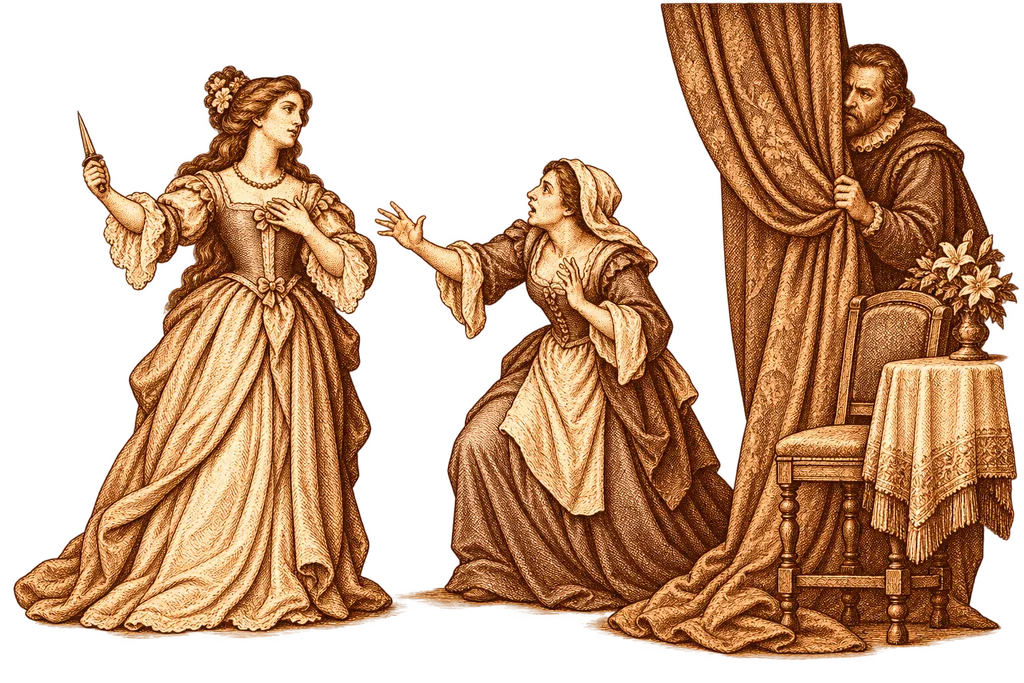
Leonela knows their secret and brings her own lover into the house. Lotario sees that man leaving and assumes, without checking, that Camila has another lover. In jealousy he arranges for Anselmo to watch secretly. Once he learns his mistake, he tells Camila. She stages a scene with Leonela and Lotario, apparently defending her fidelity with a dagger and giving herself a slight wound. Anselmo accepts the performance as conclusive proof of her virtue.
Characters and relationships
Camila changes from the unsuspecting subject of a secret test to the director of another. Leonela supports the performance, while her knowledge of the affair weakens her mistress’s authority. Lotario repeats Anselmo’s distrust by rushing to interpret what he sees.
Narration and language
The verses to Clori have different recipients within the same exchange. Anselmo believes he is directing a controlled test; Camila recognizes a genuine declaration; Lotario uses the poetic name to sustain both readings. Camila’s question about poets telling the truth sounds general while also addressing the immediate secret. Readers possess connections that Anselmo does not make.
Leonela’s relationship adds another dependence. Knowing her mistress’s secret lets her defend her own freedom of movement, while Camila fears the consequences of opposing her. The household hierarchy does not disappear, but information changes the servant’s room for action. The deception requires increasing cooperation and creates risks its authors cannot completely control.
The dagger scene turns Anselmo into the spectator of evidence prepared for him. He sees violent movements and an actual wound, then treats their material reality as confirmation of performed fidelity. What the body establishes, however, is not the account attached to it. The acting even alarms its accomplices. An apparently direct verification depends on words, positions and gestures arranged to produce a particular conclusion. The question is not only whether something happened, but who has made it mean what the observer believes.
Reading reflection
Seeing something personally does not guarantee understanding when others know they are being watched. Anselmo thinks he controls the test, but his hiding place becomes part of Camila’s script. His certainty grows stronger because he does not know how its evidence was manufactured.
What not to confuse
Camila survives the wound. The ending anticipates the deception’s exposure; its conclusion follows later.
Source and reading
Cervantes’s text in Rodríguez Marín’s La Lectura edition (1911–1913), volume 3. Checked passages: P. 216, p. 218, p. 232, p. 251, p. 255. Original summary, analysis, and reflection by QuixoteGuide.
Read the chapter in English. Read Part 1, Chapter 34 in English in John Ormsby’s translation, via Project Gutenberg. Compare it with the Spanish source cited above; our summary and commentary are separate from the translation.