The priest’s reading introduces Anselmo, whose manufactured test of fidelity endangers what he hopes to secure.
On this page
Summary
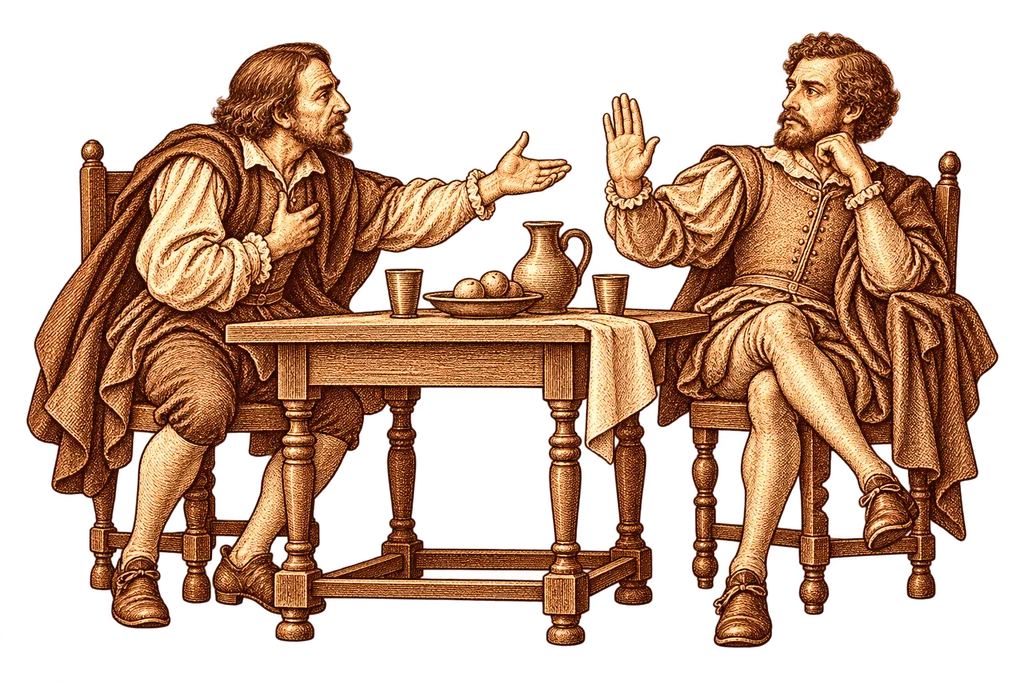
In Florence, Anselmo and Lotario are famous for their close friendship. Lotario helps arrange Anselmo’s marriage to Camila, then visits less often out of caution. Anselmo asks him to court his wife in order to test her virtue.
Lotario argues at length against the plan. Under pressure, he agrees to pretend to conduct the test while leaving Camila untouched by it. Anselmo spies on them, discovers the pretense, and demands a genuine attempt. He leaves home to make it easier. Lotario eventually falls in love and declares his desire to Camila. She withdraws and writes to her husband.
Characters and relationships
Anselmo turns friendship and marriage into instruments for his experiment. Lotario moves from warning against the danger to cooperating and then betraying his loyalty. Camila knows nothing of the men’s agreement and initially rejects the declaration.
Narration and language
The story has its own setting and cast inside the reading at the inn. Its narrator knows the characters’ thoughts and directly addresses Anselmo. Comparisons with gold and a diamond expose the test as something capable of destroying its object. Lotario’s argument also contains unequal assumptions about women that belong to his speech and call for critical reading.
Reading reflection
Anselmo seeks absolute certainty through a situation devised behind Camila’s back. His experiment no longer observes the relationship; it changes it. The demand for reassurance becomes control and damages the trust he already had.
Where the chapter stops
The ending announces Camila’s letter. Its contents and the experiment’s outcome remain for the continuation.
Source and reading
Cervantes’s text in Rodríguez Marín’s La Lectura edition (1911–1913), volume 3. Checked passages: P. 179, p. 186, p. 202, p. 209, p. 214. Original summary, analysis, and reflection by QuixoteGuide.


