A battle fought in sleep interrupts The Ill-Advised Curiosity before the priest reads its tragic conclusion.
On this page
Summary
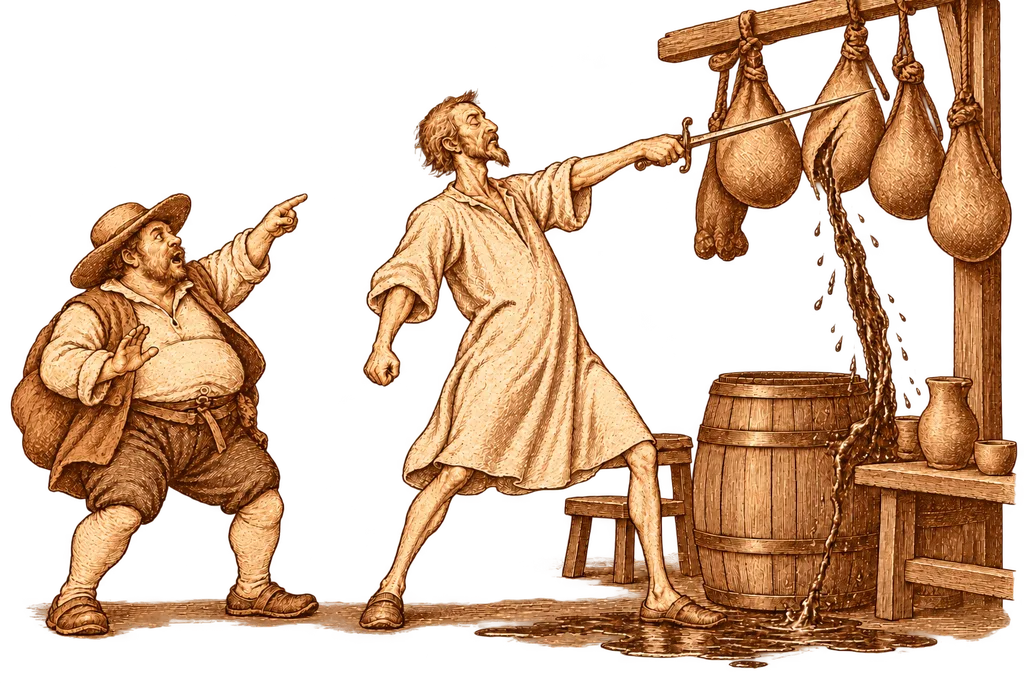
Sancho announces that Don Quixote has defeated Micomicona’s giant. The others find the knight asleep, slashing wineskins with his sword. Sancho mistakes spilled wine for blood and searches for the enemy’s head. The barber wakes Don Quixote with cold water, and the priest promises compensation to the innkeeper.
The reading resumes. Anselmo discovers Leonela’s lover and threatens her. Her promise of revelations prompts Camila to flee to Lotario. He shelters her in a convent and leaves Florence. Anselmo realizes the deception and dies while beginning a letter acknowledging his responsibility. The story then relates Lotario’s death in battle and Camila’s death after she takes religious vows on hearing the news. The priest praises the telling but questions the plausibility of Anselmo’s test.
Characters and relationships
Don Quixote acts out his dream, while Sancho clings to his hoped-for title. The innkeeper’s family bears the material loss. In the inserted story, Leonela’s secrets trigger the separation of its three central characters.
Humor and narrative techniques
The interruption abruptly returns listeners and readers to the inn’s practical concerns. Don Quixote fights in his sleep, Sancho searches for a giant’s head and the innkeeper recognizes his punctured wineskins. The imagined victory’s blood is lost wine. These perspectives have different access to the cause, although they all respond to material signs before them.
Sancho connects the supposed success to his promised reward and explains the missing head through enchantment. The innkeeper instead calculates a loss that someone must pay. Waking the knight does not finish the adventure because it leaves financial obligations for other people. These unequal outcomes make the episode more than comic relief between the misfortunes of the inserted novella.
When the reading resumes, Anselmo finally acknowledges having produced his dishonor through an unnecessary test. Death interrupts his written account, imposing a limit that another adjustment cannot repair. The priest then distinguishes the interest of the storytelling from his difficulty believing the case. Readers can enjoy an account, question its plausibility and examine its characters’ decisions without treating those three activities as identical. The return to the listening company makes that distinction part of the action.
Reading reflection
Anselmo and the travelers encounter consequences their preferred stories had concealed. Late recognition can clarify an error without restoring what was lost. The promise to pay for the wine offers a tangible kind of repair, contrasting with the inserted story’s irreversible ending.
A reading distinction
Camila’s wound in the previous chapter did not kill her. The story places her death later, after the news of Lotario’s death.
Source and reading
Cervantes’s text in Rodríguez Marín’s La Lectura edition (1911–1913), volume 3. Checked passages: P. 262, p. 263, p. 276, p. 277. Original summary, analysis, and reflection by QuixoteGuide.
Read the chapter in English. Read Part 1, Chapter 35 in English in John Ormsby’s translation, via Project Gutenberg. Compare it with the Spanish source cited above; our summary and commentary are separate from the translation.