The novel follows two paths: Don Quixote chooses his penance, while Sancho discovers that his mission lacks its essential document.
On this page
Summary
Alone in the hills, Don Quixote chooses Amadís’s penance over Roland’s destructive fury. He prays using a knotted strip of cloth, writes verses and searches for food while awaiting news of Dulcinea.
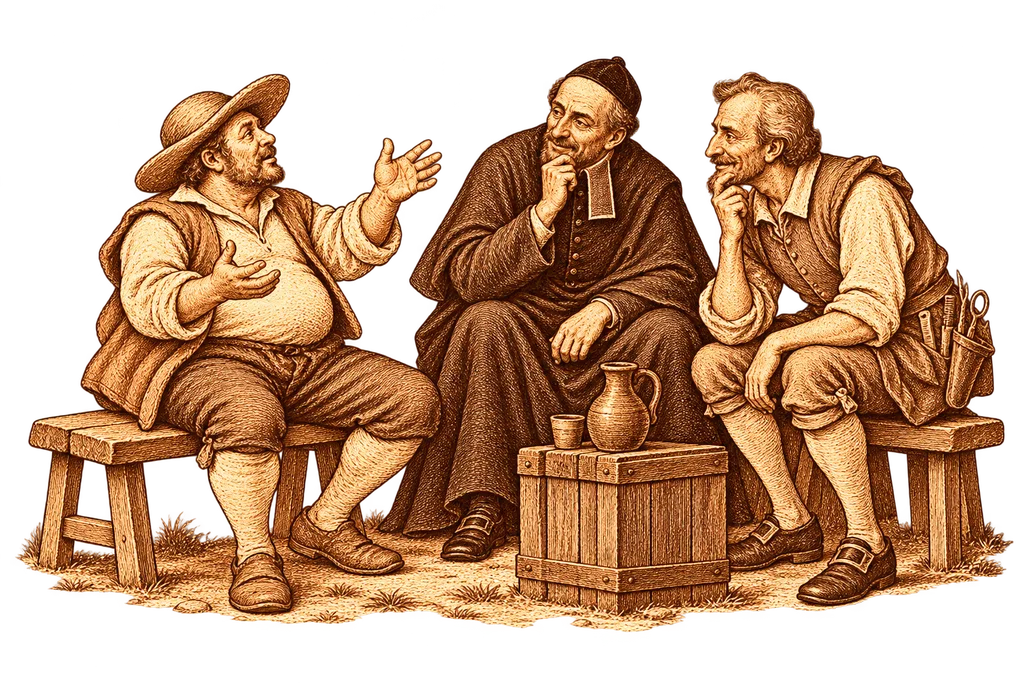
Sancho reaches the inn and meets his village priest and barber. He explains where his master is. Trying to show the letter, he discovers that Don Quixote kept the notebook. He particularly fears losing the order for donkeys, which the priest promises to renew. His oral reconstruction of the letter muddles its words and makes them laugh. They plan to invent a request for chivalric help to bring Don Quixote out of the hills and home.
Characters and relationships
Sancho retains his hopes of advancement even while describing his master’s conduct. The priest and barber understand the difficulty more clearly but enjoy his talk and choose to intervene through fiction.
Narrative techniques
A change of scene separates the knight’s waiting from the squire’s mission. Failed transmission turns written language into an unstable oral account. The rescue plan prepares a performance within the novel.
Humor, language and narrator
Elevated language changes shape in Sancho’s memory. The narrator explains an oversight the characters failed to anticipate, exposing the gap between their confidence and their actual means.
Reflection
A mission needs more than enthusiasm. Sancho leaves without checking that he has the notebook, and this omission redirects the journey. The episode gives value to an ordinary precaution: Checking what an errand requires before treating it as ready.
Source and reading
Cervantes’s text in Rodríguez Marín’s La Lectura edition (1911–1913), volume 2. Checked passages: P. 326, p. 334, p. 341. Original summary, analysis, and reflection by QuixoteGuide.


