The same recipe receives different explanations depending on who drinks it. A claim to free hospitality then leaves Sancho to bear the cost.
On this page
Summary
Don Quixote describes the fight as an adventure in an enchanted castle. He prepares the balm of Fierabrás with ingredients from the inn and prayers. He drinks, vomits, sweats and sleeps. Feeling better on waking, he considers the cure proven. Sancho drinks it and becomes ill. His master explains that someone who has not been knighted cannot benefit in the same way.
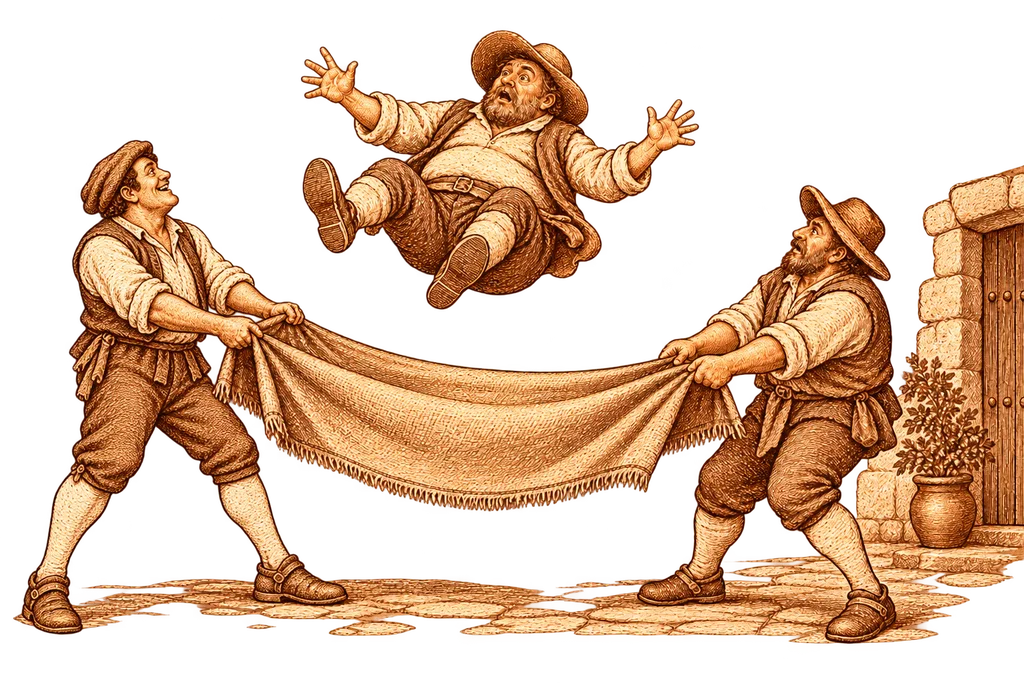
When the innkeeper presents the bill, Don Quixote acknowledges the inn but claims that knights do not pay and leaves. Sancho also refuses payment. Some men toss him in a blanket in the courtyard. Don Quixote returns and protests from outside without stopping them. Maritornes gives Sancho water and then wine. The innkeeper keeps his saddlebags against the debt.
Characters and relationships
The knight retains authority to interpret the remedy. Sancho suffers its effects and the tossing. Maritornes offers practical compassion; the innkeeper insists on the expense of hosting them.
Narrative techniques
The balm produces outcomes that receive unequal interpretations. Don Quixote vomits, sweats, sleeps and wakes feeling better. From this sequence he concludes that he has found the extraordinary remedy. Sancho takes it too but becomes far weaker. Comparing them distinguishes the described effects from the knight’s certainty about their cause. Feeling better after taking something does not by itself establish the marvelous property claimed for it.
Sancho’s bad result prompts a new condition: Perhaps the remedy benefits only people who have been knighted. The squire exposes the practical difficulty by asking why he was allowed to drink it. When his master offers it again after the blanket tossing, Sancho remembers the same condition and refuses. An argument used to explain failure becomes a reason for declining another trial.
The payment dispute reveals another consequence of imagined privilege. Don Quixote wants to repay the stay through future heroic service, while the innkeeper requires money. The knight leaves, and Sancho remains vulnerable to violent entertainment he cannot control. Maritornes brings water. Her limited, concrete assistance contrasts with the promise of a complete cure that he now refuses to accept.
Humor, language and narrator
The solemn recipe meets vomiting and illness. Blanket tossing turns a refusal to pay into the movement of Sancho’s body. His suffering complicates the amusement.
Reflection
Something free for one person may impose a cost on another. Don Quixote protects his knightly status while Sancho receives the punishment. Maritornes’s water and wine provide practical care that heroic speeches fail to supply.
Source and reading
Cervantes’s text in Rodríguez Marín’s La Lectura edition (1911–1913), volume 2. Checked passages: P. 57, p. 58, p. 62, p. 66, p. 68. Original summary, analysis, and reflection by QuixoteGuide.
Read the chapter in English. Read Part 1, Chapter 17 in English in John Ormsby’s translation, via Project Gutenberg. Compare it with the Spanish source cited above; our summary and commentary are separate from the translation.