Sancho turns a painful obligation into a financial agreement. Don Quixote counts the blows without seeing that his squire has changed where they land.
On this page
Characters and setting
Characters: Don Quixote and Sancho Panza. Helen and Dido are represented in the inn’s paintings. Setting: The road toward the village, a wooded place where the lashes are faked, and an inn.
Summary
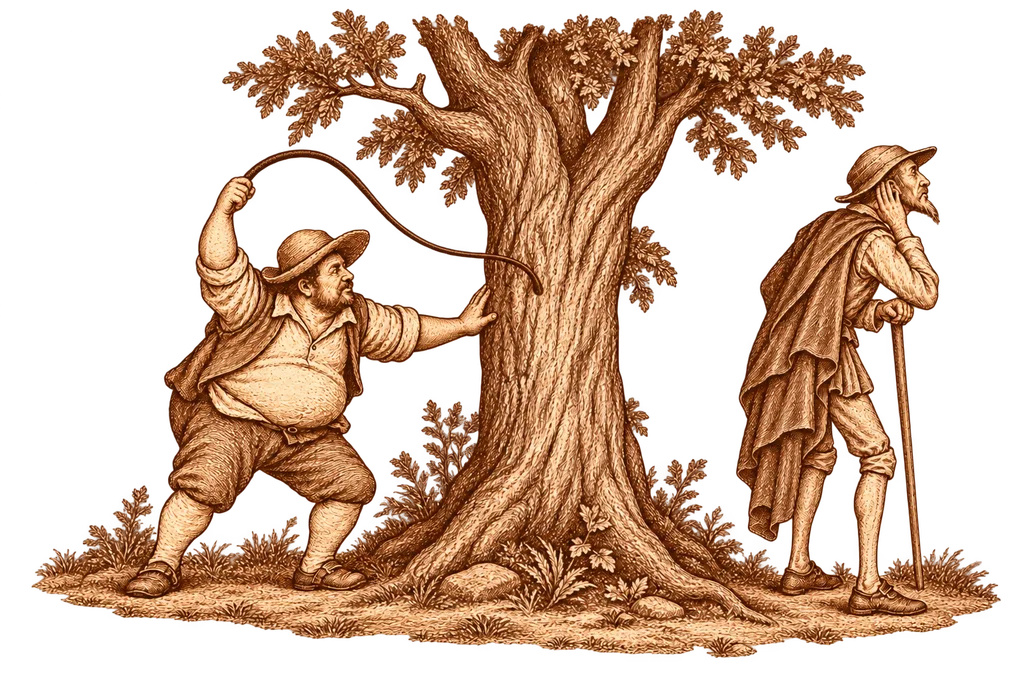
Leaving the castle, Sancho complains that the promised shirts never arrived. Don Quixote acknowledges the failure and offers payment for the lashes meant to release Dulcinea. Sancho sets a price and begins that night. After a few real blows, he requests a higher rate; his master agrees. Sancho then strikes trees while making sounds of pain. Concerned for his life, Don Quixote stops him, covers him and postpones the rest. At an inn they examine paintings of Helen and Dido. The knight imagines preventing their misfortunes; Sancho anticipates pictures of their own adventures. Their conversation returns to the unauthorized Quixote’s poor representation and the remaining lashes.
What to notice
Readers see the switch from Sancho’s back to trees while Don Quixote merely listens and counts. Recognizing an inn does not mean every chivalric imagining has disappeared.
Analysis
The complaint about unfulfilled shirts turns Sancho’s supposed healing power into labor demanding payment. Don Quixote acknowledges the failure and agrees to remunerate the lashes for Dulcinea. The squire’s new willingness does not establish that penance happens as his master believes: After a few actual blows, he renegotiates the rate and directs his force against trees.
The knight counts sounds and hears groans, evidence appearing sufficient because he trusts the scene he is hearing. Injured bark and a protected back separate accounting from actual sacrifice. Sancho now employs resources of performance previously used against him. This deception has concrete financial and bodily aims; it need not become a comprehensive theory of his character.
Don Quixote’s response adds care to the exchange. He interrupts the task, remembers Sancho’s wife and children, and accepts that Dulcinea can wait rather than risk his companion’s life. Paintings of Helen and Dido then shift discussion toward represented stories whose outcomes he imagines changing through an impossible knightly intervention. Both lashes and pictures require distinctions between what is displayed, what is imagined and what can actually be done. The chapter holds calculation and affection together without making either disappear.
A reflection for today
Counting an activity does not prove that it happened in the intended way. Audible blows provide a signal Don Quixote mistakes for the act itself. The episode offers a reflection on agreements whose measures can appear satisfied while their purpose remains unverified.
Sources and edition
This guide uses Cervantes’s text in Francisco Rodríguez Marín’s La Lectura edition (1911–1913), volume 8, II.71. Verifiable locator: Identifier donquijotedelama08cerv, scan images 282–296 (zero-based digital index). The heading and selected passages were visually checked; the complete notes were not collated. Analysis and present-day reflection are this guide’s commentary.
Read the chapter in English. Read Part 2, Chapter 71 in English in John Ormsby’s translation, via Project Gutenberg. Compare it with the Spanish source cited above; our summary and commentary are separate from the translation.