Prevented from seeking adventures, Don Quixote proposes another life drawn from literature. Sancho joins the imagining but adds needs and dangers an ideal landscape cannot remove.
On this page
Characters and setting
Characters: Don Quixote and Sancho Panza. Tosilos, Teresa, Sanchica, Sansón, the priest and the barber appear in conversation or in the proposed plan. Setting: The road home near the earlier pastoral performance, and the countryside where they spend the night.
Summary
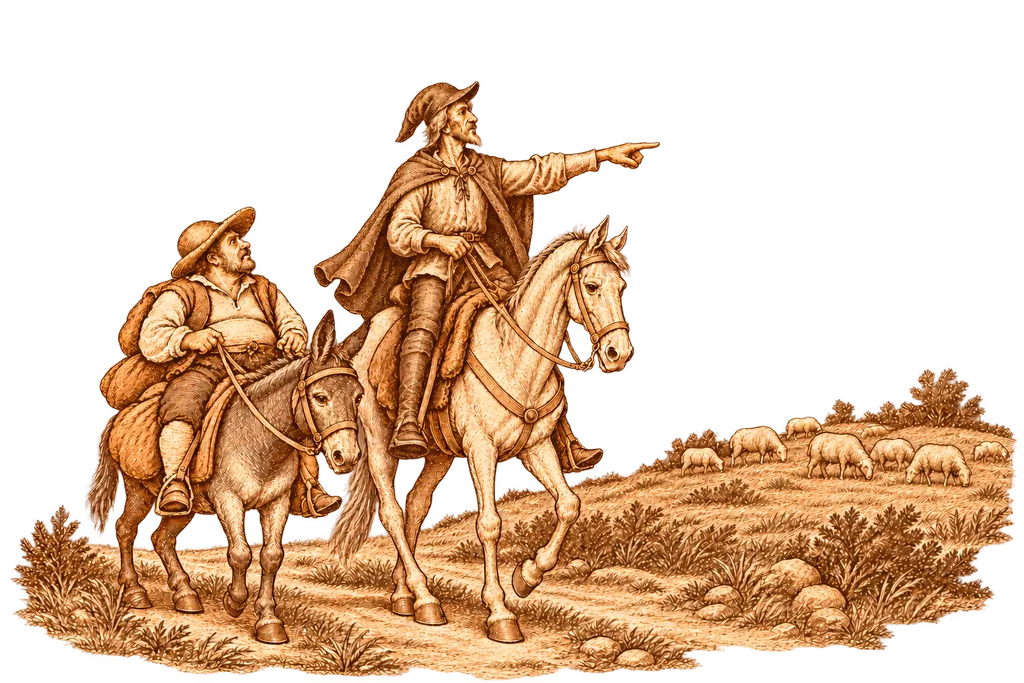
Sancho returns after eating with Tosilos. Don Quixote insists that the servant was transformed and asks about Altisidora, distinguishing gratitude from love. He again demands Dulcinea’s lashes; Sancho questions how his suffering could undo an enchantment. Passing the place of the pastoral performance and the bulls, the knight proposes becoming a shepherd during retirement. He would be Quijotiz and Sancho, Pancino; they imagine recruiting Sansón, the barber and the priest. They discuss lovers’ names, poetry and instruments. Sancho retains Teresa as the subject of his poems and fears for Sanchica if she brings them food. They argue again about proverbs. Spending the night outdoors, Sancho sleeps while Don Quixote remains awake.
What to notice
This is a plan, not a pastoral life already underway. Sancho challenges the lashes’ supposed effectiveness and remembers that dangerous desires exist in the countryside too.
Analysis
A change of literary genre preserves Don Quixote’s imaginative activity. Required to abandon knighthood, he hopes to maintain fame, love and companionship through pastoral poetry. Sancho shares his enthusiasm without treating the countryside as guaranteed innocence. Family concerns introduce friction into the new ideal.
A reflection for today
A different activity can help someone through an enforced pause. The chapter invites us to distinguish a workable alternative from exchanging one fantasy for another. Shared imagining also requires attention to those expected to feed, accompany or support the project.
Sources and edition
This guide uses Cervantes’s text in Francisco Rodríguez Marín’s La Lectura edition (1911–1913), volume 8, II.67. Verifiable locator: Identifier donquijotedelama08cerv, scan images 224–236 (zero-based digital index). The heading and selected passages were visually checked; the complete notes were not collated. Analysis and present-day reflection are this guide’s commentary.

