Don Quixote begins interpreting his defeat while Sancho continues exercising practical judgment. Tosilos brings news that undermines another alleged magical transformation.
On this page
Characters and setting
Characters: Don Quixote; Sancho Panza; the countrymen discussing the race; Tosilos. Setting: The road home from Barcelona and the places where they meet the countrymen and Tosilos.
Summary
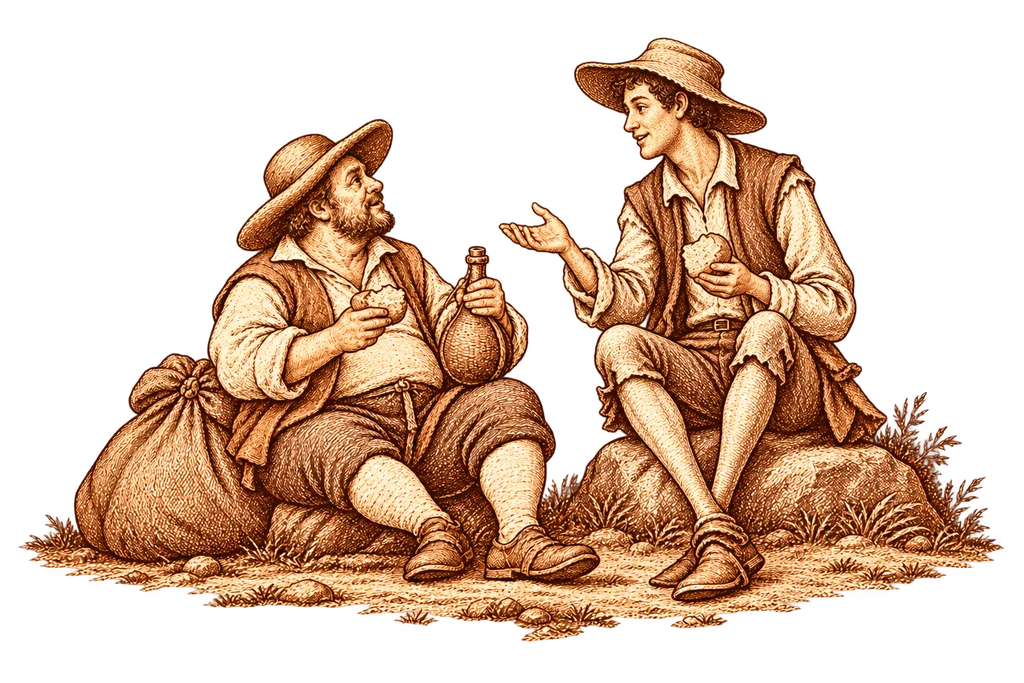
Leaving Barcelona, Don Quixote mourns his fall and Sancho advises endurance. The knight admits that he misjudged Rocinante’s weakness against the rival horse and promises to keep his word. They discuss the burden of the weapons and Sancho’s sore feet without abandoning the equipment. In a village they hear about a race between men of unequal weight: One wants the other loaded with iron. Sancho reverses the demand, proposing that the challenger reduce his own weight; the discussion ends with a suggestion to spend part of the stake on wine. Later they meet Tosilos. The servant reports that the duke punished him for refusing combat, the young woman entered a convent and Doña Rodríguez returned to Castile. Don Quixote insists on enchantment. Sancho shares food with Tosilos, then catches up with his master.
What to notice
Defeat also receives a material explanation through the horses. Sancho exposes unfair terms by reversing the challenge’s logic. Tosilos says he was always the same servant.
Analysis
Don Quixote retains an obligation he can fulfill after losing the contest. He acknowledges defeat, considers the unequal horses and keeps his promise to return. This moral continuity neither removes sadness nor makes every subsequent judgment clear. Revision is uneven: He can reconsider one decision while rejecting explanations that threaten his chivalric framework.
The race dispute lets Sancho briefly recover the role of judge without returning to Barataria. A heavier runner wants the lighter man loaded with iron to equalize their weights; the squire reverses the demand and proposes that the challenger reduce his own. The answer exposes how numerical equality can conceal a disadvantage imposed by whoever establishes the terms. It is a comic intervention in a bargain, rather than guidance about bodies or exercise.
Tosilos then reports consequences absent from the combat’s festive conclusion. He says he received a hundred blows, Rodríguez’s daughter entered a convent and her mother returned to Castile. Don Quixote maintains an explanation of enchantment; Sancho accepts food with the messenger. Hearing information and defending an interpretation again separate the companions. Their departure from the castle had not ended the scheme’s effects on the duke’s dependants.
A reflection for today
When a project fails, we can acknowledge a mistaken calculation without punishing those who carried it out. Sancho rejects directing frustration at Rocinante, the weapons or his feet. The episode encourages responsibility to receive as much attention as the outcome.
Sources and edition
This guide uses Cervantes’s text in Francisco Rodríguez Marín’s La Lectura edition (1911–1913), volume 8, II.66. Verifiable locator: Identifier donquijotedelama08cerv, scan images 210–222 (zero-based digital index). The heading and selected passages were visually checked; the complete notes were not collated. Analysis and present-day reflection are this guide’s commentary.
Read the chapter in English. Read Part 2, Chapter 66 in English in John Ormsby’s translation, via Project Gutenberg. Compare it with the Spanish source cited above; our summary and commentary are separate from the translation.