On Barcelona’s beach, defeat brings lasting consequences. Don Quixote loses the contest and accepts the end of his adventures while remaining loyal to Dulcinea.
On this page
Characters and setting
Characters: Don Quixote; Sancho Panza; the Knight of the White Moon; the viceroy; Don Antonio Moreno; Ana Félix. Setting: Barcelona, especially the beach where the contest takes place.
Summary
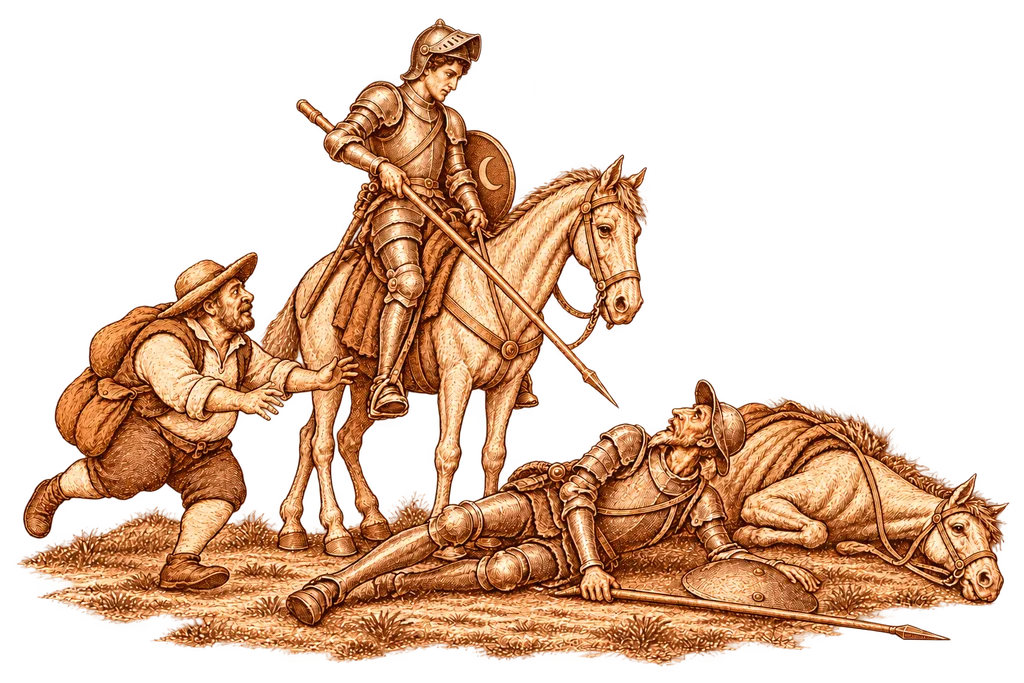
As Don Gregorio’s rescue is arranged, Don Quixote offers to perform it himself, and Sancho questions the problem of crossing the sea. One morning, the Knight of the White Moon challenges him over his lady’s superior beauty. If Don Quixote loses, he must return to his village and lay down his arms for a year. The viceroy, assuming the encounter is probably a prank, allows it. The rival knocks down Rocinante and his rider without striking him with the lance’s point. Defeated, Don Quixote maintains Dulcinea’s beauty and asks to die rather than deny it. His opponent accepts that loyalty and demands only the agreed retirement. Sancho sees his hopes collapse; the battered knight is carried into the city.
What to notice
Retirement is agreed before the contest. The White Moon raises his lance during the charge: Victory need not mean killing. His identity is explained in the next chapter.
Analysis
Force determines the protagonist’s future without proving a claim about Dulcinea. He acknowledges physical defeat while retaining his ideal of love. The viceroy’s permission exposes a danger in treating everything as entertainment: What he considers a performance produces a serious obligation and real suffering.
A reflection for today
Losing a contest does not automatically disprove every conviction we hold. Yet the consequences accepted on entering it also matter. The chapter allows personal loyalty to be distinguished from the need to honor an agreed limit.
Sources and edition
This guide uses Cervantes’s text in Francisco Rodríguez Marín’s La Lectura edition (1911–1913), volume 8, II.64. Verifiable locator: Identifier donquijotedelama08cerv, scan images 186–195 (zero-based digital index). The heading and selected passages were visually checked; the complete notes were not collated. Analysis and present-day reflection are this guide’s commentary.

