Don Antonio Moreno promises harmless amusement but exposes his guest to attention he does not understand. A false marvel and a printing shop show two ways of manufacturing stories.
On this page
Characters and setting
Characters: Don Quixote; Sancho Panza; Don Antonio Moreno, his wife and nephew; guests, dancers and printing-shop workers. Setting: Don Antonio’s house, Barcelona’s streets and a printing shop.
Summary
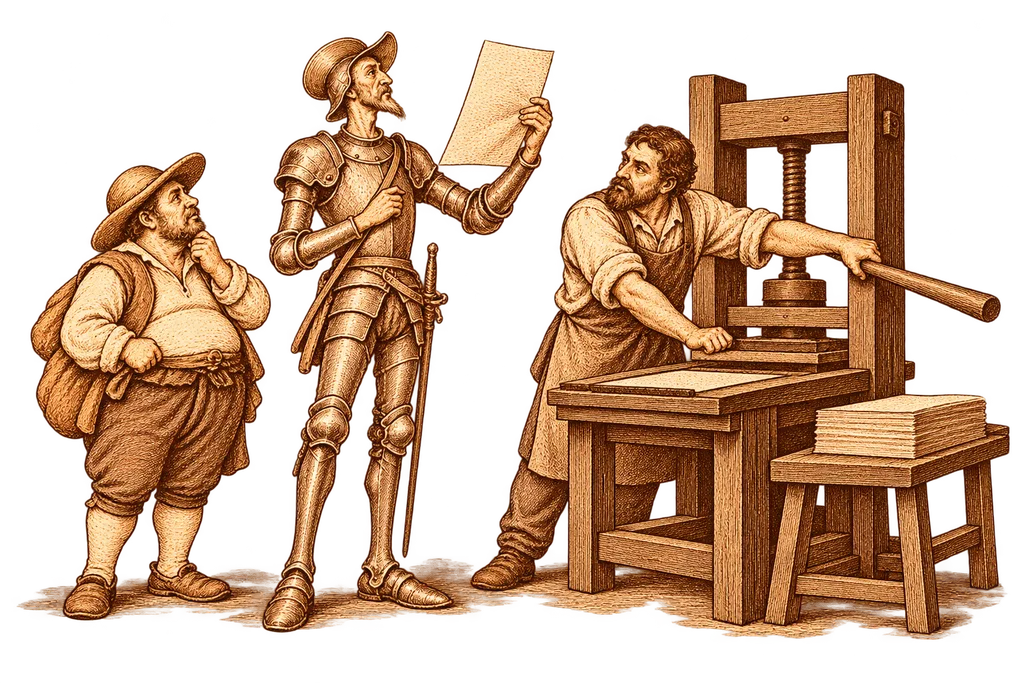
Don Antonio displays Don Quixote and arranges a ride with a sign on his back explaining why everyone recognizes him. During a dance, the knight rejects flirtation and becomes exhausted. The following day, a supposedly enchanted head answers questions: Don Quixote gains hope about Dulcinea, while Sancho finds its replies obvious. The narrator reveals the mechanism: Hidden tubes carry the voice of a nephew in the room below. Don Quixote and Sancho do not learn this explanation. They later visit a printing shop, where the knight discusses translation and publishing income. Finding the unauthorized continuation of his story in production, he leaves in anger.
What to notice
Readers know about both the sign and the head’s mechanism. Don Quixote’s remarks on translation include admired exceptions, rather than rejecting all translation.
Analysis
Don Antonio manufactures recognition with a sign fastened to his guest’s back. Don Quixote attributes people’s knowledge of his name to chivalric fame without seeing its material explanation. The incident anticipates the head’s mechanism: In each case he receives a real effect without understanding the human operation producing it.
The narrator explains the concealed tube and the nephew’s voice so that readers do not mistake the head for a confirmed marvel. Its answers combine prior information with cautious formulations; Sancho can consider them obvious while his master finds hope concerning Dulcinea. Credibility also depends on what each questioner wants to hear. Knowledge of the apparatus separates readers from the characters without requiring both companions to be treated as equally credulous.
The printing shop shifts attention to another process of manufacture. Don Quixote observes composition, correction and workshop labor, discusses translation and encounters the rival book in production. Texts shaping his fame have workers, costs and commercial interests as well as readers. Voice and writing are connected through their material devices. His final irritation cannot erase what the visit reveals: A representation circulates through processes its protagonist may inspect and dispute while remaining unable to control them.
A reflection for today
An apparently intelligent answer invites questions about who produces it and what they already know. The head does not depict a modern technology, but it offers a useful comparison concerning hidden mechanisms and apparent authority. The printing shop raises a further question about commercial interests in circulating stories.
Sources and edition
This guide uses Cervantes’s text in Francisco Rodríguez Marín’s La Lectura edition (1911–1913), volume 8, II.62. Verifiable locator: Identifier donquijotedelama08cerv, scan images 136–163 (zero-based digital index). The heading and selected passages were visually checked; the complete notes were not collated. Analysis and present-day reflection are this guide’s commentary.
Read the chapter in English. Read Part 2, Chapter 62 in English in John Ormsby’s translation, via Project Gutenberg. Compare it with the Spanish source cited above; our summary and commentary are separate from the translation.