The promised island enters family discussion. Teresa and Sancho imagine different futures for their daughter and consider what a title would really change.
On this page
Characters and setting
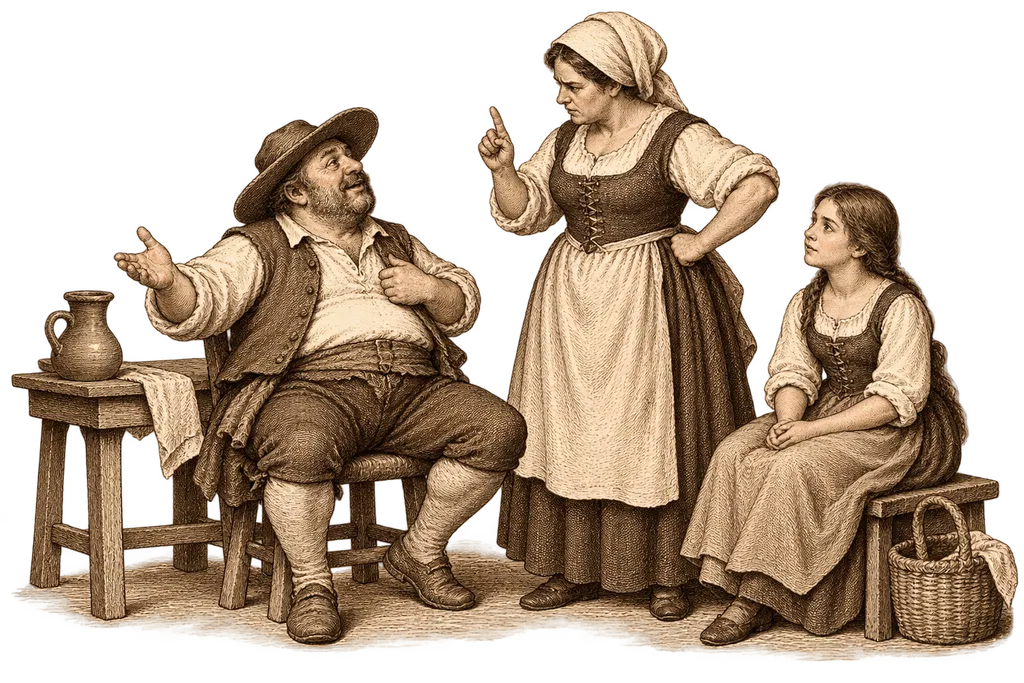
Characters: Sancho and Teresa Panza; their daughter Mari Sancha is the subject of their family discussion. Setting: Sancho and Teresa’s home.
Summary
Sancho tells Teresa he will accompany Don Quixote again, combining hopes of improvement with sadness at leaving. She prioritizes his safe return and recalls their children's needs. Sancho wants Mari Sancha to marry above her current station once he has a governorship. Teresa favors a known young man of their own condition and fears humiliation in an unfamiliar social setting. They argue about names, clothing, money and prestige. The fictional translator raises doubts about the sophistication of Sancho's speech.
What to notice
Teresa supplies her own reasons and concrete examples rather than simply receiving news. The translator's suspicion invites us to ask who decides what language a character can possess.
Analysis
Advancement is weighed against familial and social costs. Sancho trusts that present appearances will replace memories of humble origins; Teresa fears the change will expose those origins more sharply. No observed success settles the argument: Both anticipate a hypothetical future, while the narrative voice complicates how their conversation reaches readers.
A reflection for today
Before accepting a promotion, a family may consider benefits alongside changes in relationships, residence or treatment by others. Listening to specific concerns keeps the decision from becoming only a matter of title. Teresa and Sancho provide a way to explore that discussion without claiming every social improvement leads to isolation.
Sources and edition
This guide uses Cervantes’s text in Francisco Rodríguez Marín’s La Lectura edition (1911–1913), volume 5, II.5. Verifiable locator: Identifier donquijotedelama05cerv, scan images 101–114 (zero-based digital index). The heading and selected passages were visually checked; the complete notes were not collated. Analysis and present-day reflection are this guide’s commentary.

