Sancho answers gaps noticed by readers. Discussing what has already been written becomes a plan for further adventures and a negotiation of the squire's role.
On this page
Characters and setting
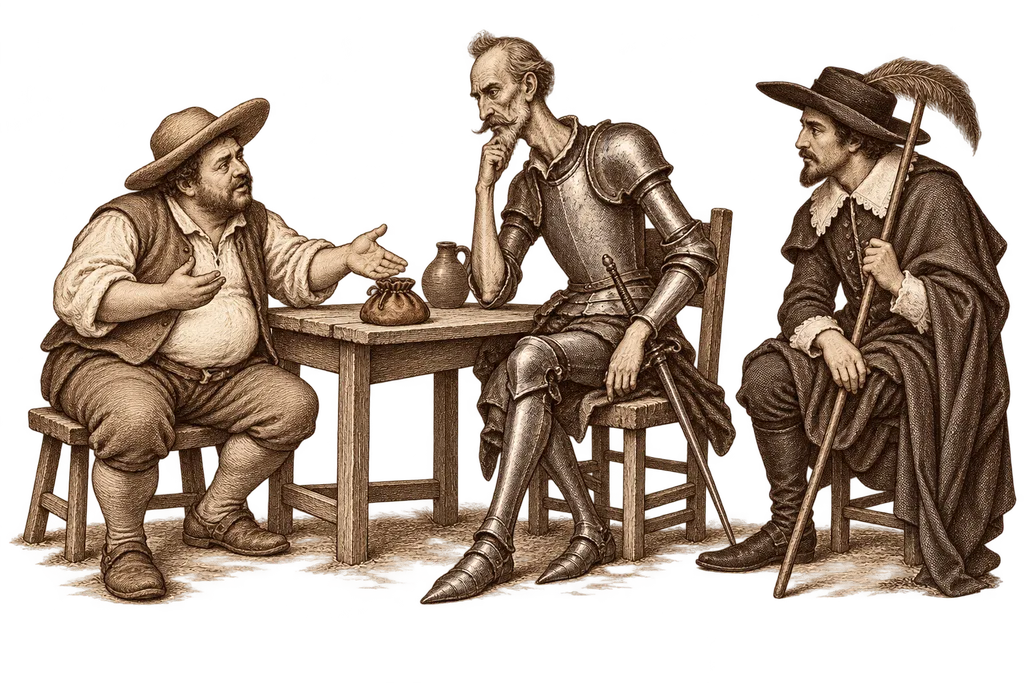
Characters: Don Quixote, Sancho and Sansón Carrasco; Ginés de Pasamonte appears in the recollection of the donkey’s theft. Setting: Don Quixote’s house during the discussion of the book and the next journey.
Summary
Sancho explains how his donkey was stolen while he slept and how he later recognized Ginés de Pasamonte riding it. Faced with the printed account's inconsistency, he suggests carelessness by the historian or printer. He says the hundred crowns were spent on his family. The three discuss a possible continuation. Don Quixote decides to set out again, and Carrasco suggests Zaragoza. Sancho distinguishes courage from recklessness: He wants to serve faithfully but does not accept fighting as his own obligation.
What to notice
The explanations clarify events without erasing the contradiction already present in the book. Sancho sets specific limits on service while continuing to hope for a governorship.
Analysis
Sancho claims a part in the account describing him, answering for money and an animal central to his life. Plans for the journey also emerge in the presence of readers and potential sequels. Living and being narrated begin to shape one another, yet Sancho tries to distinguish accompanying his master from reproducing his exposure to danger.
A reflection for today
A collaboration becomes clearer when responsibilities and limits are discussed before work begins. Sancho's warning makes that conversation worth considering without reducing it to disloyalty. The chapter also demonstrates the value of acknowledging a published inconsistency instead of pretending it was never there.
Sources and edition
This guide uses Cervantes’s text in Francisco Rodríguez Marín’s La Lectura edition (1911–1913), volume 5, II.4. Verifiable locator: Identifier donquijotedelama05cerv, scan images 87–100 (zero-based digital index). The heading and selected passages were visually checked; the complete notes were not collated. Analysis and present-day reflection are this guide’s commentary.

