While Sancho talks with Teresa, Don Quixote's household tries to prevent another departure. Domestic care and social position meet an ideal of virtue that he uses to justify his path.
On this page
Characters and setting
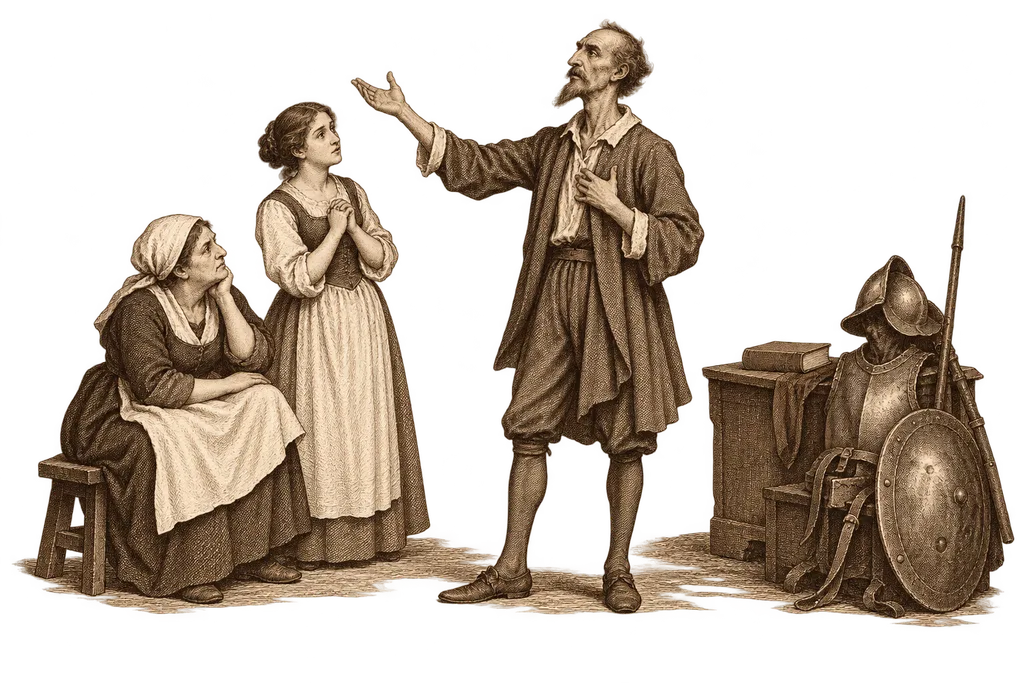
Characters: Don Quixote, the housekeeper and the niece; Sancho arrives at the end. Setting: Don Quixote’s house.
Summary
The housekeeper suggests court service instead of a dangerous journey. Don Quixote distinguishes a courtly knight from a knight-errant and praises direct experience of the world. His niece challenges the truth of his books and points to his age, health and means. He answers by classifying lineages and argues that virtue, generosity and considerate behavior give a poor knight worth. He declares his commitment to arms. Sancho's arrival interrupts the discussion.
What to notice
The niece acknowledges her uncle's knowledge and ability while rejecting his conclusions. His account of virtue contains intelligible reasoning, but it does not establish that his imagined adventures are feasible.
Analysis
A moral defense can be coherent in some respects and fail when applied to one's own situation. Don Quixote transfers the value of generosity into justification of his wandering identity. The women answer with bodily and material circumstances. The scene allows both dimensions to be heard without making eloquence a resolution.
A reflection for today
Choosing a project for its values also calls for questions about ability and resources. The niece points to conditions affecting implementation, rather than only disputing the ideal. That distinction can help assess our plans without confusing a practical objection with wholesale rejection of something we value.
Sources and edition
This guide uses Cervantes’s text in Francisco Rodríguez Marín’s La Lectura edition (1911–1913), volume 5, II.6. Verifiable locator: Identifier donquijotedelama05cerv, scan images 115–127 (zero-based digital index). The heading and selected passages were visually checked; the complete notes were not collated. Analysis and present-day reflection are this guide’s commentary.

