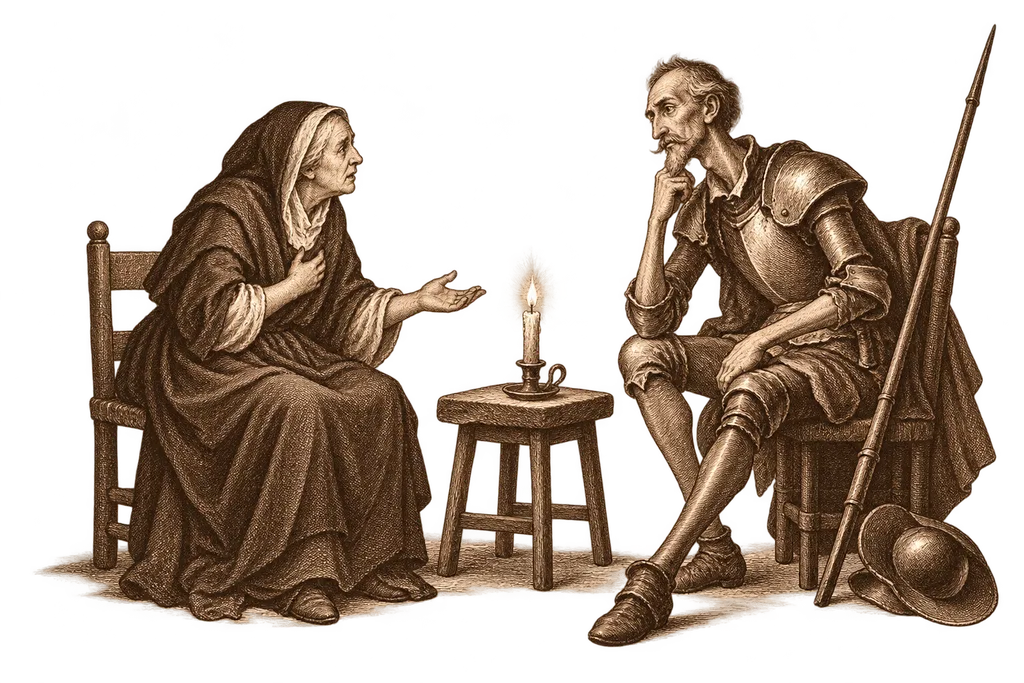
A nighttime visit brings Don Quixote a need that was not invented for the hosts’ amusement. Doña Rodríguez asks for help for her daughter and exposes the palace’s dependencies.
On this page
Characters and setting
Characters: Don Quixote; Doña Rodríguez; Rodríguez’s daughter (in her mother’s account); the unidentified attackers. Setting: Don Quixote’s room.
Summary
The knight first expects Altisidora, then fears an apparition. The visitor is Doña Rodríguez. After mutual alarm and elaborate assurances of propriety, she recounts her life as a servant, wife, and widow before explaining her daughter’s grievance.
A wealthy farmer’s son seduced the daughter under a promise of marriage and now refuses to keep it. Rodríguez says the duke ignores her complaint because the young man’s father lends him money and guarantees his debts. She then criticizes Altisidora and reveals the medicinal openings in the duchess’s legs. Unidentified people burst into the darkened room, beat the duenna, and pinch Don Quixote; their identities remain undisclosed.
What to Notice
Comic misunderstandings give way to a social conflict. Rodríguez still speaks through the language of rank and honor, but her complaint reveals financial interests beneath the palace’s magnificent appearance.
Analysis
Doña Rodríguez enters a bedroom where Don Quixote expects temptation or fears an apparition. Assurances of propriety must first clear away those expectations. Her request differs from the earlier adventures: A servant of this very household seeks help for a daughter promised marriage. Distress is present inside the house that manufactures distant misfortunes for amusement.
Rodríguez offers an economic explanation. According to her, the duke neglects the case because the young man’s father lends him money and guarantees his debts. That attribution matters: The chapter presents a mother’s accusation, rather than an independent investigation. Nevertheless, it poses a concrete question about access to justice when the person expected to intervene depends on someone connected with the grievance.
Revealing the duchess’s medical treatments changes the danger of speaking. Behind a seemingly flawless appearance, Rodríguez exposes a body requiring care; shortly afterward, unidentified people attack both speakers in the dark. The narrator postpones naming them. This delay makes fear and uncertainty available before explanation. Reading ahead should preserve the distinction between what the characters undergo, what they suppose and what the narrative later confirms. That distinction is especially important in a household where staged marvels and real injuries repeatedly overlap.
Reading It Today
Original reflection: A complaint can be blocked when the person responsible for examining it depends on someone implicated in the case. Rodríguez looks elsewhere after repeated requests go unanswered. The modern analogy draws attention to dependencies and to the possibility of being heard outside a circle with an interest in silencing the grievance.
Sources and Text
Miguel de Cervantes, Don Quijote de la Mancha, Part 2, Chapter 48. Francisco Rodríguez Marín edition, Madrid, La Lectura, 1911–1913, volume 7. Facsimile passages consulted: P. 220; p. 222. Chapter text at the Centro Virtual Cervantes.
Read the chapter in English. Read Part 2, Chapter 48 in English in John Ormsby’s translation, via Project Gutenberg. Compare it with the Spanish source cited above; our summary and commentary are separate from the translation.