The proposed remedy requires a journey on a wooden horse. Sancho shifts attention to his own role: Why should he take risks when someone else will receive the credit?
On this page
Characters and setting
Characters: Don Quixote; Sancho; Trifaldi; the attendants playing the bearded duennas; Doña Rodríguez; the duke and duchess. Setting: The ducal garden; Candaya (the claimed destination).
Summary
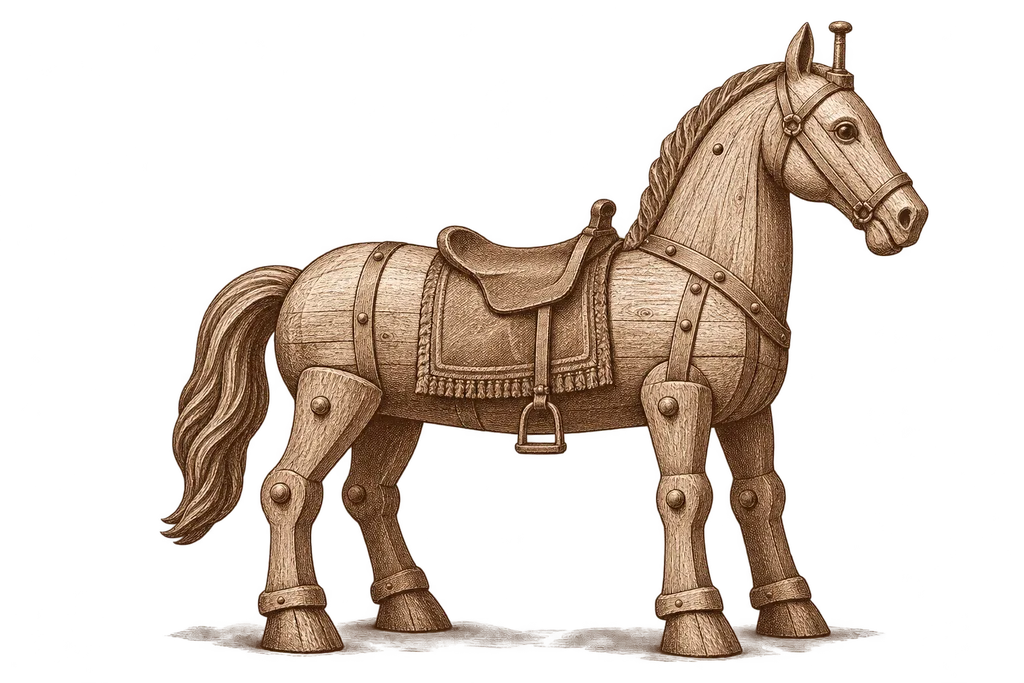
Trifaldi explains that Malambruno will send Clavileño, a wooden horse supposedly steered through the air by a peg. Don Quixote and his squire must ride it to Candaya. Sancho asks about its name, capacity, and controls, then refuses to sit on its hard hindquarters to solve someone else’s problem.
His objection extends to how adventures are recorded: Historians celebrate the knight while omitting the squire’s essential assistance. Another quarrel about duennas follows. Don Quixote remains determined to help, and Trifaldi’s final plea moves Sancho to decide that he will accompany his master.
What to Notice
The opening praises Cide Hamete’s attention to detail, while Sancho complains about a potential omission in chivalric history: The assistant’s labor. Both interventions make the act of telling the story part of the adventure itself.
Analysis
We focus on the connection between recognition and cooperation. Sancho asks for more than a comfortable ride: He wants the squire’s contribution to be named. His eventual compassion motivates him without settling that inequality. Clavileño’s powers remain claims made by Trifaldi inside the staged deception, rather than a narrator’s confirmation that the horse can fly.
Reading It Today
Original reflection: A project’s success may become attached to its public representative while other people’s indispensable work disappears. Sancho asks for an account that includes collaboration. His objection suggests a practical question for today’s celebrations: Who is named in the acknowledgments, and who is noticed only when more effort is needed?
Sources and Text
Miguel de Cervantes, Don Quijote de la Mancha, Part 2, Chapter 40. Francisco Rodríguez Marín edition, Madrid, La Lectura, 1911–1913, volume 7. Facsimile passages consulted: P. 61. Chapter text at the Centro Virtual Cervantes.
