Trifaldi reaches the punishment behind her appeal: The giant Malambruno supposedly transformed the lovers and gave every duenna a beard.
On this page
Characters and setting
Characters: Trifaldi; Trifaldín; Sancho; Don Quixote; the duke and duchess; Malambruno (in Trifaldi’s story). Setting: The ducal garden; Candaya (in Trifaldi’s story).
Summary
Trifaldi says that the church judge recognized Clavijo and Antonomasia’s marriage, after which Queen Maguncia died of grief. Sancho considers the reaction excessive and questions whether the bridegroom’s status justified such despair.
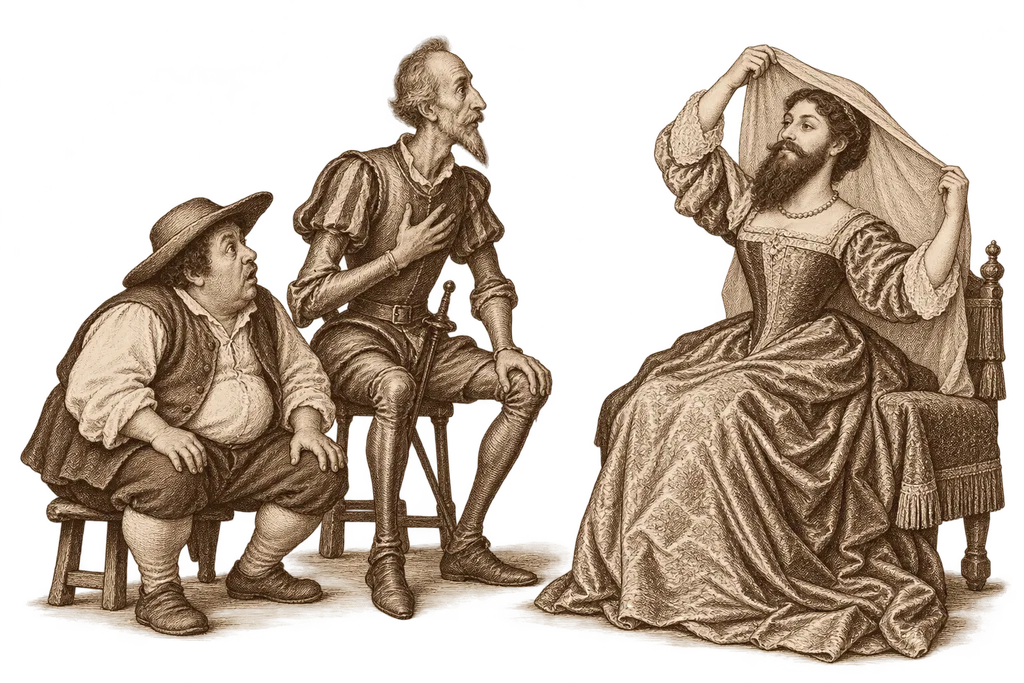
According to the countess, Malambruno changed Antonomasia into a bronze ape and Clavijo into a metal crocodile. An inscription assigns Don Quixote the combat required to free them. Rather than execute Trifaldi, the giant allegedly punished all the duennas for her actions by covering their faces with beards. They lift their veils to display the supposed enchantment.
What to Notice
A marriage dispute becomes a supernatural threat. The beards are revealed only after their meaning has been explained, so words prepare the interpretation of what the characters see. Sancho repeatedly interrupts the solemn account with practical objections.
Analysis
Our focus is the distribution of blame: Trifaldi says the others were punished for an intervention she attributes to herself. This injustice inside her story helps mobilize the knight. The narrative remains a deception known to readers; displaying the beards does not establish that Malambruno exists outside the performance.
Reading It Today
Original reflection: Punishing a whole group for one person’s decision can replace individual responsibility with a shared label. Trifaldi’s account exaggerates that mechanism. In a present-day comparison, the useful question is what each person actually did before accepting blame defined by an occupation or group membership.
Sources and Text
Miguel de Cervantes, Don Quijote de la Mancha, Part 2, Chapter 39. Francisco Rodríguez Marín edition, Madrid, La Lectura, 1911–1913, volume 7. Facsimile passages consulted: P. 50. Chapter text at the Centro Virtual Cervantes.
