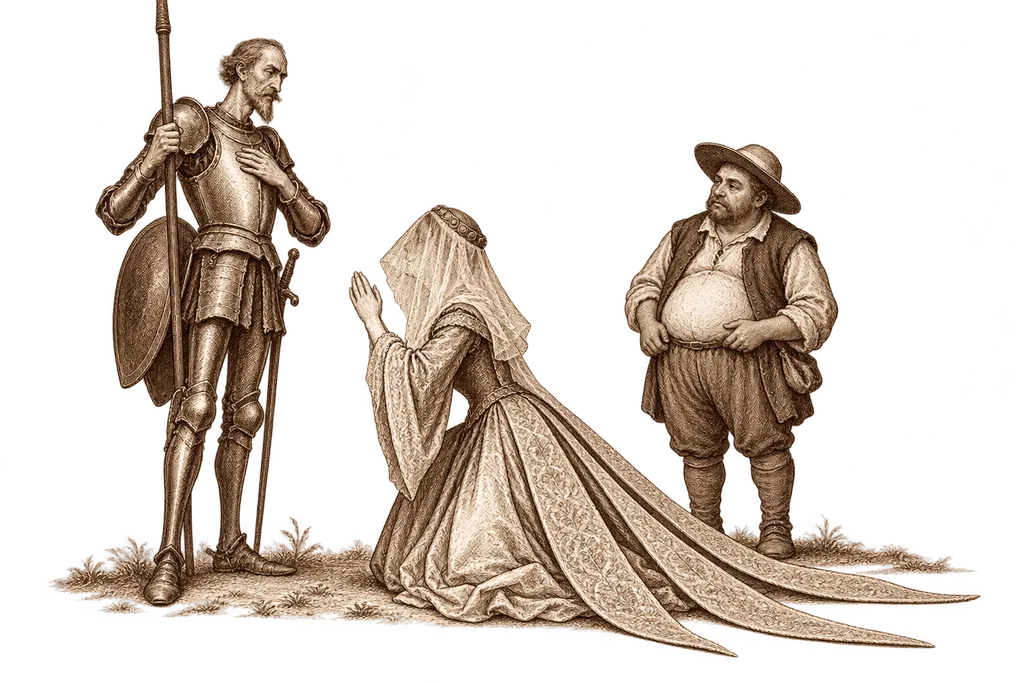
Trifaldi arrives with a procession of duennas and turns her appeal into a story of seduction, poetry, and unequal marriage. Readers still know that the hosts arranged this performance.
On this page
Characters and setting
Characters: Trifaldi; Trifaldín; Don Quixote; Sancho; the duke and duchess; Antonomasia and Clavijo (in Trifaldi’s story). Setting: The ducal garden; Candaya (in the staged story).
Summary
The countess’s three-pointed train explains her name. She appeals to the knight and squire, then describes raising Antonomasia, heir to Candaya. Don Clavijo, a private gentleman skilled in music and verse, first won over the young woman’s guardian in order to reach her.
Trifaldi blames seductive poetry but eventually acknowledges her own weakness. The lovers’ relationship rests on a marriage pledge; pregnancy prompts them to seek recognition from a church judge. The difference between Clavijo’s rank and the princess’s position is presented as the obstacle. The outcome awaits the next chapter.
What to Notice
Exaggerated superlatives spread to Sancho, who imitates the countess’s ceremonial speech. Her attack on poetry moves between blaming the seducer and admitting her own responsibility. Candaya also has poets, officials, and customs familiar enough for Sancho to recognize his own world in it.
Analysis
We read the speech as an account that invokes powerful causes before identifying the person who made access possible. Trifaldi first describes irresistible verses, then admits her intervention. Narrative levels remain crucial: Antonomasia and Clavijo belong to a story told inside a staged deception, rather than to an adventure the protagonists have personally witnessed.
Reading It Today
Original reflection: Blaming a persuasive campaign for an error can obscure the choices of those who enabled it. Trifaldi eventually identifies what she herself did. The modern analogy encourages us to reconstruct actions and responsibilities alongside the appeal of the message that persuaded someone.
Sources and Text
Miguel de Cervantes, Don Quijote de la Mancha, Part 2, Chapter 38. Francisco Rodríguez Marín edition, Madrid, La Lectura, 1911–1913, volume 7. Facsimile passages consulted: P. 42. Chapter text at the Centro Virtual Cervantes.
