The fictional historian qualifies the account of Montesinos. A later roadside meeting returns conversation to poverty and military service.
On this page
Characters and setting
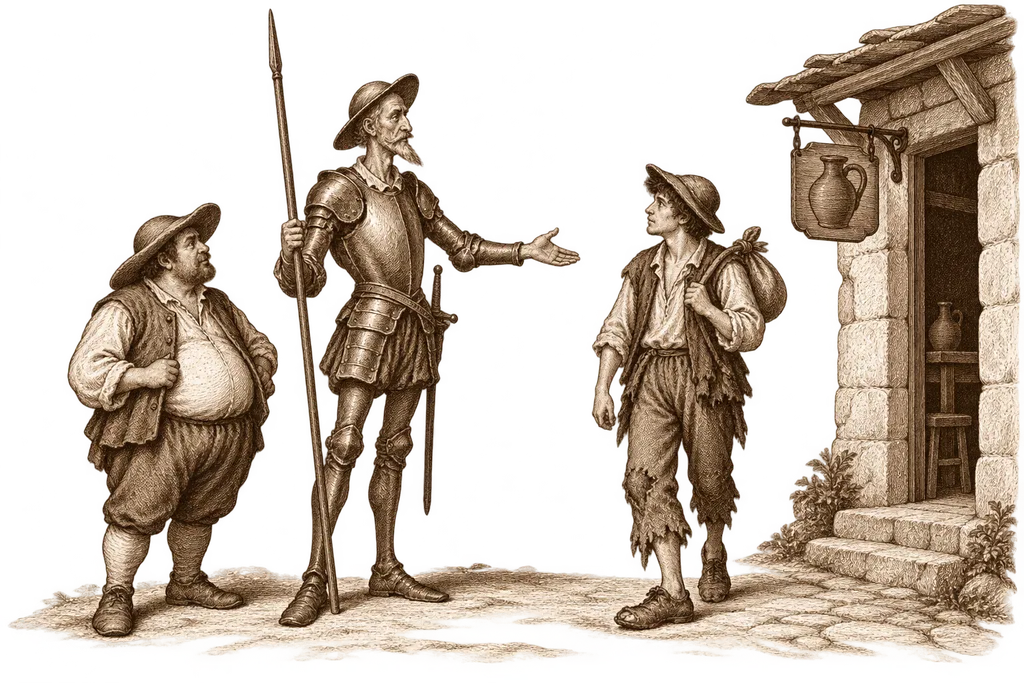
Characters: Don Quixote, Sancho, the cousin, a man carrying weapons and the young man going to enlist. Setting: The road, a hermitage and the inn they reach.
Summary
The translator reports a note by Cide Hamete, who cannot decide whether the cave adventure is true or false and leaves judgment to the reader. The cousin nevertheless wants to use it as information for his books. The travelers meet a man carrying weapons who promises his story at an inn. They also stop at a hermitage without finding the drink Sancho wants. Further on, a poor young man explains that he is going to enlist. Don Quixote praises military service, discusses soldiers' difficulties and offers him supper. On arrival, he recognizes the inn as an inn.
What to notice
Cide Hamete's note adds uncertainty rather than proving one definitive version. The cousin extracts supposed certainties from an account whose authority has just been questioned.
Analysis
The chapter presents different responses to a source: Withholding judgment or adopting it for an explanation already desired. In the young man's story, concrete poverty accompanies Don Quixote's ideal of military honor. Both dimensions belong in the reading.
A reflection for today
A useful detail can look firmer than its origin warrants. The cousin encourages us to preserve a source's reservations when reusing it instead of removing them as its contents become our own assertions.
Sources and edition
This guide uses Cervantes’s text in Francisco Rodríguez Marín’s La Lectura edition (1911–1913), volume 6, II.24. Verifiable locator: Identifier donquijotedelama06cerv, scan images 118–134 (zero-based digital index). The heading and selected passages were visually checked; the complete notes were not collated. Analysis and present-day reflection are this guide’s commentary.

