Don Quixote reports an experience combining romance heroes, geography and his recent encounter with the peasant women. Sancho listens with knowledge his master lacks.
On this page
Characters and setting
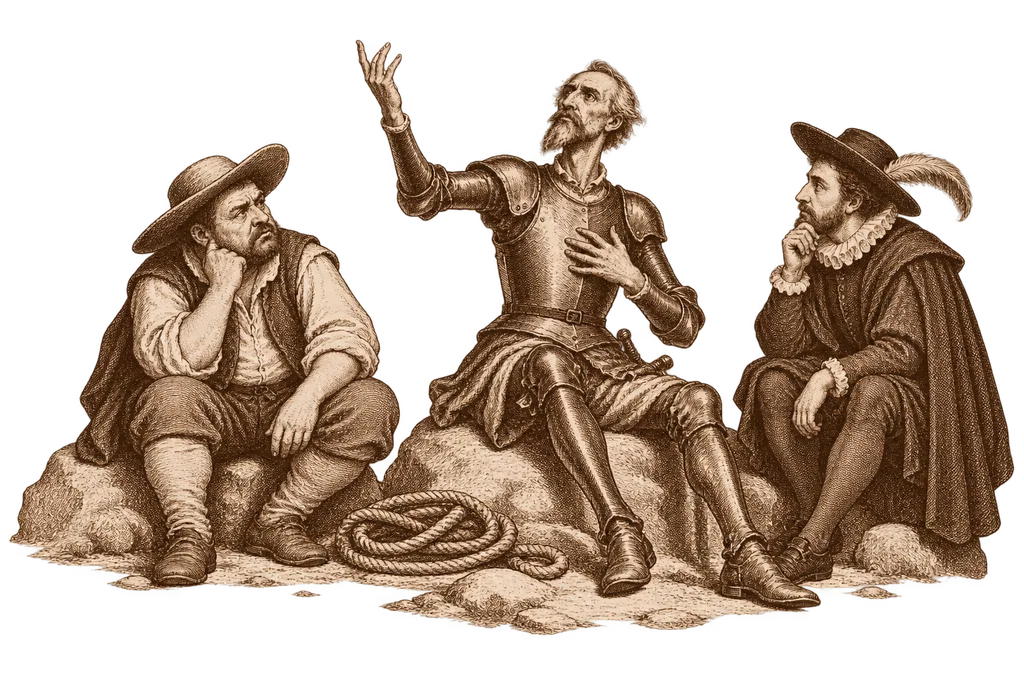
Characters: Don Quixote, Sancho and the cousin. Montesinos, Durandarte, Belerma and Dulcinea appear in the experience Don Quixote reports. Setting: Outside the cave; the enchanted meadow and palace belong to the knight’s account.
Summary
Don Quixote says he fell asleep during the descent and awoke in a wonderful meadow beside a palace. Montesinos showed him Durandarte and Belerma, enchanted by Merlin, and explained the transformations of Guadiana and Ruidera. Several days passed for the knight, while his companions measured a much shorter absence. He claims to have seen Dulcinea with the same women met near El Toboso. An attendant requested money for her, and he gave what he had. Sancho, who invented the enchantment, rejects the account's credibility. Don Quixote insists that he saw and touched what he describes.
What to notice
The wonders belong to Don Quixote's account; a second witness does not certify them. Conflicting measures of time and Sancho's knowledge complicate a straightforward literal reading.
Analysis
The adventure reaches readers through Don Quixote’s voice after his companions have drawn him from the cave. Montesinos, Durandarte and Belerma belong to the world he reports, not to a scene also witnessed by Sancho. This mode of transmission matters when assessing details. Precision about a name or object does not turn one person’s testimony into shared verification. The discrepancy between the knight’s experienced duration and the waiting time measured above supplies the clearest contrast.
Dulcinea’s appearance connects the vision to Sancho’s invention near El Toboso. The squire therefore has a particular reason for suspicion, recognizing a fiction for which he was responsible. A request for money also introduces an everyday need into an extraordinary setting. Don Quixote must explain how enchanted people can suffer material hardship rather than preserving a grandeur free of practical necessities. Ask what knowledge enables each listener to assess the report and what information remains unavailable. The chapter need not force an immediate choice between accepting every detail and calling the knight a deliberate liar. It exposes a distance among personal conviction, remembered reading and evidence other people can inspect, while leaving the listeners’ different reasons for doubt in view.
A reflection for today
Listening to someone convinced of an experience does not require treating all their explanations as shared facts. The conversation allows respect for the person to coexist with attention to contradictions in their account.
Sources and edition
This guide uses Cervantes’s text in Francisco Rodríguez Marín’s La Lectura edition (1911–1913), volume 6, II.23. Verifiable locator: Identifier donquijotedelama06cerv, scan images 92–116 (zero-based digital index). The heading and selected passages were visually checked; the complete notes were not collated. Analysis and present-day reflection are this guide’s commentary.
Read the chapter in English. Read Part 2, Chapter 23 in English in John Ormsby’s translation, via Project Gutenberg. Compare it with the Spanish source cited above; our summary and commentary are separate from the translation.