After the wedding, Don Quixote wants to test the wonders of Montesinos's cave. His companions see a physical descent and a sleeping return; the account of what he saw comes later.
On this page
Characters and setting
Characters: Don Quixote, Sancho, Basilio, Quiteria and the graduate’s cousin, who acts as their guide. Setting: The stay with the newlyweds, followed by the Cave of Montesinos.
Summary
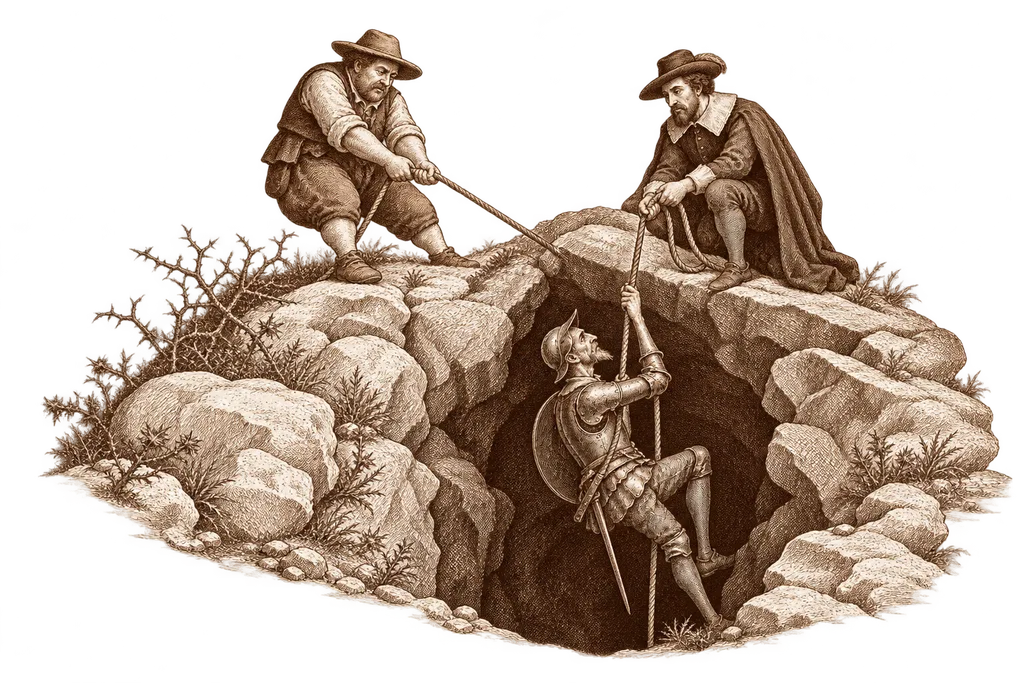
The newlyweds host Don Quixote and Sancho and explain that Quiteria did not know Basilio's stratagem. The knight advises Basilio to earn a living for their marriage. The graduate's cousin guides them towards Montesinos and describes scholarly books he plans to write. Sancho tests these projects with comic questions. They buy rope and reach the cave. Don Quixote cuts through its entrance vegetation and descends while tied to the rope. Sancho and the cousin eventually haul him up with his eyes closed. Once awakened, he laments leaving an extraordinary vision and prepares to describe it.
What to notice
The external narrative has not yet shown the marvellous interior. Readers first receive the observable actions of those who remain above.
Analysis
The newlyweds’ hospitality corrects the suspicion that Quiteria knew the device in advance and raises a question following the triumph: How will they support their life together? Don Quixote advises Basilio to secure resources. Mutual love and skill at disrupting a ceremony do not themselves provide a livelihood. The observation gives the wedding consequences beyond the marriage rather than treating the union as the sufficient end of every difficulty.
The cousin offers another route to usefulness by gathering curiosities for his books. Sancho’s questions test the value of that learning before they reach the cave. The rope then establishes a particular material dependence. Don Quixote can explore because others remain above and hold him. When they draw him out with closed eyes, his companions know the waiting time and his body’s condition, but cannot observe what he claims to have experienced. That unequal access prepares the following chapter’s dispute. Separate events witnessed at the entrance from the story they will subsequently hear. Neither the rope nor his sleep proves everything that might be reported about the interior, although both supply points against which to examine the report. The setting creates a problem of testimony alongside an adventure of exploration.
A reflection for today
Recording testimony requires preserving the difference between what several people observed and what only one reports. The rope, the wait and the return provide shared evidence; the wonders require a separate assessment.
Sources and edition
This guide uses Cervantes’s text in Francisco Rodríguez Marín’s La Lectura edition (1911–1913), volume 6, II.22. Verifiable locator: Identifier donquijotedelama06cerv, scan images 72–90 (zero-based digital index). The heading and selected passages were visually checked; the complete notes were not collated. Analysis and present-day reflection are this guide’s commentary.
Read the chapter in English. Read Part 2, Chapter 22 in English in John Ormsby’s translation, via Project Gutenberg. Compare it with the Spanish source cited above; our summary and commentary are separate from the translation.