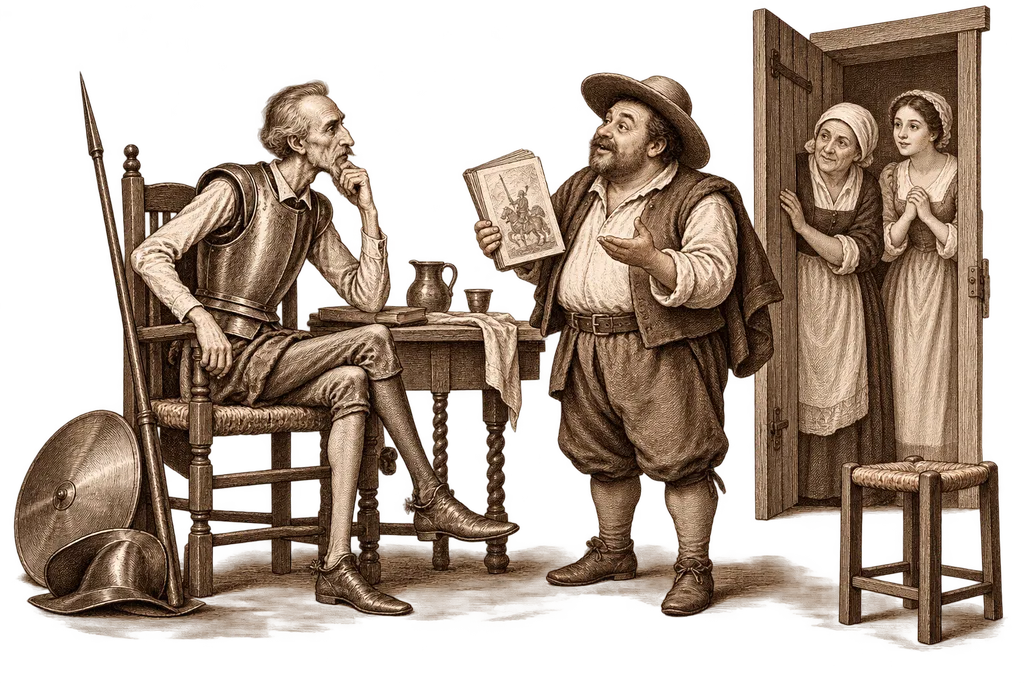
Sancho returns to his master and meets resistance at the door. Their private exchange turns from the journey home toward reputation and a book about them both.
On this page
Characters and setting
Characters: Don Quixote, Sancho, the housekeeper and the niece. Sansón Carrasco is mentioned as the source of news about the book. Setting: Don Quixote’s house: The doorway and his private conversation with Sancho.
Summary
The housekeeper and niece blame Sancho for encouraging the journeys; he recalls that Don Quixote attracted him with the promise of an island. Alone, they debate whether master and servant share one another's pain. Sancho points to being abandoned during the blanket-tossing. Don Quixote asks what the neighbors think of him. Sancho reports unflattering judgments and announces that Sansón Carrasco, newly returned from Salamanca, knows a printed history containing their names and adventures. The knight asks him to bring the bachelor.
What to notice
The image of a head and its limbs suggests solidarity, but Sancho tests it against a painful experience. News of the book makes the protagonists potential readers of their own representation.
Analysis
Their relationship permits a specific protest without ending. Sancho questions whether hierarchy guarantees mutual care, then becomes a mediator of public opinion. Don Quixote's reputation no longer depends only on the ideal he constructs: Other descriptions circulate beyond his control.
A reflection for today
Saying that everyone shares a risk does not prove its costs are equally distributed. Sancho encourages comparing a claim of solidarity with what actually happened. News of the book also reminds us that reputation depends on accounts created by others, rather than only on our preferred self-presentation.
Sources and edition
This guide uses Cervantes’s text in Francisco Rodríguez Marín’s La Lectura edition (1911–1913), volume 5, II.2. Verifiable locator: Identifier donquijotedelama05cerv, scan images 53–66 (zero-based digital index). The heading and selected passages were visually checked; the complete notes were not collated. Analysis and present-day reflection are this guide’s commentary.

